Monday, September 24, 2012

Dredd 3D Review

Rated R (Strong Bloody Violence, Language, Drug Use and some Sexual Content)

Running Time: 1 Hour & 35 Minutes

Cast-
Karl Urban-Judge Joseph Dredd
Olivia Thirlby-Judge Cassandra Anderson
Lena Headey- Madeline Madrigal/Ma-Ma
Wood Harris-Kay
Warrick Grier-Caleb
Langley Kirkwood-Judge Lex
Edwin Perry-Judge Alvarez
Karl Thaning-Judge Chan
Michele Levin-Judge Kaplan
Domhnall Gleeson-Clan Techie
Rakie Ayola-Chief Judge

Directed by Pete Travis

"I am the law!" Karl Urban prepares to dispense some justice in "Dredd 3D."
When it comes to remakes, sometimes I wonder if Hollywood studio executives are actual people or really monkeys wearing expensive suits. For instance, take August's "Total Recall," a totally unnecessary remake that spectacularly failed to capture the nuance of the Arnold Schwarzenegger original or the Philip K. Dick short story that it's based on. Instead, director Len Wiseman opted to throw a deluge of meaningless CG effects in a transparent attempt to mask his film's shortcomings. I just do not understand why Hollywood insists on remaking good movies but not the bad ones. The recent release of "Dredd 3D" is one of those rare examples where a remake actually makes sense, as the original was downright terrible. Based on the U.K. 2000 AD comic book character created by John Wagner and Carlos Ezquerra in 1977, 1995's "Judge Dredd" starred Sylvester Stallone as the titular character but the film was a massive flop with critics (16% on Rotten Tomatoes) and audiences, grossing a paltry $34.7 million at the domestic box office, although it was modest success overseas with $78.8 million. Expressing his dislike for the original, Wagner remarked in a recent interview with Empire magazine that it 'had nothing to do with Judge Dredd, and Judge Dredd wasn't really Judge Dredd.' Even Stallone admitted that it was 'a real missed opportunity.' Although writer Alex Garland began working on the script as early as 2006, development on a new film adaptation wasn't formally announced until December 2008 as an independent project under British studio DNA Films. With director Pete Travis at the helm and Karl Urban as Dredd himself, filming finally commenced in Cape Town, South Africa in November 2010. Brutally violent yet grounded in realism, "Dredd 3D" may not break any new ground or offer anything that can be called original but it remains a tightly edited and highly entertaining piece of genre filmmaking. 

In the distant future, a devastating nuclear war has transformed much of the United States into an irradiated wasteland known as the Cursed Earth. The surviving human populations now reside in massive metropolis' called mega-cities, with the largest being Mega-City One, which covers much of the east coast of North America from Boston to Washington, D.C. and is home to over 800 million residents. Cesspools of crime, unemployment, and poverty, the only people who are able to contain the violence are the Judges, law enforcement officers granted with the powers of judge, jury, and executioner. After taking down a group of thugs in a high-speed chase, Judge Dredd (Karl Urban) is ordered to return to the Hall of Justice and meet with the Chief Judge (Rakie Ayola), who tasks him with evaluating a rookie named Cassandra Anderson (Olivia Thirlby), a psychic who failed her exam to become a full Judge. Meanwhile, a drug kingpin named Madeline Madrigal, nicknamed Ma-Ma (Lena Headey), who rules the 200-story slum tower block Peach Trees with an iron fist and controls the distribution of a powerful narcotic known as 'Slo-Mo' (which slows the user's perception of time to 1% of actual speed), decides to make an example of three small-time dealers by flaying and throwing their bodies from the top of the tower. Dredd and Anderson decide to investigate the triple homicide, busting up a drug den for information and arresting Kay (Wood Harris), one of Ma-Ma's key distributers of Slo-Mo. Anderson psychically learns that Kay was involved in the murders but just to be sure, Dredd decides to bring him to the Hall of Justice to be interrogated. When Ma-Ma learns of his capture, she has her henchman Caleb (Warrick Grier) seize control of the tower's security control room and seal the building using its blast shields under the pretense of doing a test on their security system. Trapped inside the tower, Dredd and Anderson must now battle against Ma-Ma's army of thugs and bring her to justice if they are to escape. 

I think it goes without saying that "Dredd 3D" is a massive improvement over the laughable Stallone version. Part of the reason that the film works so well lies in its simplicity. After a short narration from Dredd that provides just enough background information on the world he lives in, the plot immediately segues into the character dispensing violent justice in the streets of Mega-City One. It's not long before he and his protégé Anderson find themselves trapped inside a 200-story tower in the Peach Trees housing block, forcing them into a desperate battle for their lives in order to escape. It bears a passing resemblance to last year's Indonesian action film "The Raid: Redemption" (although this one was completed way before director Gareth Evans began production on his) and even "Attack the Block" but "Dredd 3D" avoids being a carbon copy by using its limited setting to emphasize the brutality that exists in this dystopian vision of the future. Writer Alex Garland chooses to avoid fleshing out Dredd, allowing his actions to speak for themselves in lieu of traditional character development and depicting him as a relentless force of nature. The interactions between him and rookie Anderson and the situation they find themselves in provide further insight into their respective personalities. There are some hints of Dredd hiding something behind his gruff exterior but he remains an enigma, as it should be. Anderson functions as an effective audience stand-in and Garland often uses her as a way to ease viewers who may not be familiar with the source material rather than blunt the action with awkward exposition. 

Compared to similar genre fare like the recent "Resident Evil Retribution," the action in "Dredd 3D" is low-key and relies on practical effects over CG. Grounded in realism despite the film taking place in the future, Dredd isn't presented as some superman that can engage in massive shootouts and expect to survive. He uses his environment to his advantage and rations his ammunition but even then, we are reminded that he is mortal and can be killed. The only action scene that approaches being over-the-top is when Ma-Ma's men uses three Gatling guns in a futile attempt to kill the two Judges, completely destroying an entire floor in the tower and reducing it to a pile of rubble. "Dredd 3D" is quite violent but never in a way that approaches parody. In terms of visuals, the scenes that stand out are the ones where various characters take a hit of Slo-Mo, where the slowing down of time creates these beautiful images that are both surreal and unnerving at the same time. The overall aesthetic was managed by British cinematographer Anthony Dod Mantle, who creates a stylish yet foreboding atmosphere within the tower. The design of the Judge's weapon also deserves a special mention. Dubbed the 'Lawgiver' and resembling a mini-submachine gun, the firearm has a variety of voice-activated modes such as armor-piercing rounds or explosives. Hell, I half-expected it to make Dredd a sandwich! While the film was shot in native 3D, the confined space in which "Dredd 3D" takes place in doesn't allow for much depth and the added effect only benefits the Slo-Mo scenes. Still, it's utilized in a creative and subtle enough manner to justify the ticket surcharge. 

As the titular character, Karl Urban is simply perfect in the role. Never removing his helmet once, Urban actually creates a rather nuanced performance, showing Dredd as harsh but never impractical and even displaying a dry sense of humor. His gruff delivery of 'I am the law' sends chills down your spine. The youthful Olivia Thirlby also handles herself pretty well, her character determined to use violence when necessary yet remains sympathetic to the plight of others, a trait that impresses even the stoic Dredd. Finally, there's Lena Headey as the violent drug kingpin Ma-Ma. With her facial scars and wild hair, Headey is a delight to watch even though her confrontation with Dredd proves to be underwhelming. 

"Dredd 3D" was released on September 21, 2012 to surprisingly positive reviews with 77% on Rotten Tomatoes. Praising the 'bombastic violence and impressive special effects,' critics concluded that it was 'a rare example of a remake that actually works.' Although the film received strong reviews and tons of online buzz during a screening at this year's San Diego Comic Con, it ended up bombing at the box office with a measly weekend debut of $6.3 million. The problem lies with the fact that mainstream audiences do not read comics and are not as invested compared to so-called 'fanboys.' Strangely, people seemed to be more interested in the generic PG-13 horror flick "House at the End of the Street" rather than a legitimately good film. Granted, the production budget was only an estimated $45 million so it may yet turn a modest profit overseas, enough to warrant a sequel. "Dredd 3D" does not reinvent the wheel but the direction, the tone, and the violence all combine to create one highly entertaining action film.

Final Rating: 4 out of 5

"In case you have forgotten, this block operates under the same rules as the rest of the city. Ma-Ma is not the law...I am the law."

Saturday, September 22, 2012

Resident Evil: Retribution Review

Rated R (Sequences of Strong Violence Throughout)

Running Time: 1 Hour & 36 Minutes

Cast-
Milla Jovovich-Alice
Sienna Guillory-Jill Valentine
Michelle Rodriguez-Rain Ocampo
Li Bing-Bing-Ada Wong
Johann Urb-Leon S. Kennedy
Boris Kodjoe-Luther West
Kevin Durand-Barry Burton
Oded Fehr-Carlos Olivera
Colin Salmon-James 'One' Shade
Shawn Roberts-Albert Wesker
Aryana Engineer-Becky
Megan Charpentier/Ave Merson-O'Brian-The Red Queen
Ali Larter-Claire Redfield (archive footage only)
Wentworth Miller-Chris Redfield (archive footage only)

Directed by Paul W.S. Anderson

Milla Jovovich suits up again to kick some zombie butt for "Resident Evil Retribution," the fifth installment in this never-ending series.
Like clockwork, Activision releases a new Call of Duty video game annually every November with only the smallest of changes between new installments; only the time period in which the game takes place in changes. Despite the increasing disillusionment among gamers with the franchise, Call of Duty continues to sell millions of copies around the world and it's due to the fact that there are many people out there who only play this one game year after year. Just to put this in perspective, last year's Call of Duty Modern Warfare 3 sold over 6.5 million copies across all platforms in the first 24 hours in the U.S. and U.K. alone, grossing a massive $400 million and making it the biggest entertainment launch of all time. Call of Duty is a series that will never end so long as there is money to be made. Similarly, the "Resident Evil" film franchise, based upon the video games owned and published by Capcom, continues to soldier on like the Energizer Bunny with the latest installment "Resident Evil Retribution." The series has always managed to turn a profit at the box office for Screen Gems/Sony Pictures thanks to the modest production budgets, with 2010's "Resident Evil Afterlife" earning $296 million worldwide. The previous four films have grossed $754.5 million combined. Frankly, I'm amazed that "Resident Evil" managed to even last this long and while it has always provided some cheap thrills thanks to the action scenes, the series is now way past its expiration date. Lacking any coherent plot or even worthwhile characters, "Resident Evil Retribution" offers more of the same and not much else. Those who are already fans of the films will be satisfied but for everyone else, this is just a lazy, cynical cash-grab. 

Picking up immediately after the events of "Afterlife," Alice (Milla Jovovich), Claire and Chris Redfield (Ali Larter and Wentworth Miller) are under attack by soldiers employed by the unscrupulous Umbrella Corporation, led by a mind-controlled Jill Valentine (Sienna Guillory). They storm the freighter Arcadia and during the ensuing battle, Alice is knocked unconscious into the ocean while Claire and Chris are captured. Waking up deep inside an Umbrella facility, Alice is interrogated by Jill but a sudden power failure allows her to escape. Alice finds herself in downtown Tokyo and is forced to battle with a horde of zombies. She makes her way to the facility's control room and encounters Ada Wong (Li Bing-Bing), an assassin for Umbrella who now works for Albert Wesker (Shawn Roberts). Wesker explains to Alice that she is currently trapped in an underwater facility in what was formerly Russia where Umbrella would run simulations for prospective customers who were curious in how people would react to a particular outbreak. However, the facility is now under the control of the Red Queen (voice of Ave Merson-O'Brian), an advanced artificial intelligence now hell-bent on destroying the remnants of humanity. Despite his sinister intentions, Wesker wants to help Alice escape and has a sent a small strike team, led by Leon S. Kennedy (Johann Urb), to assist her. To prevent their escape, the Red Queen sends Jill and a group of Umbrella soldiers consisting of clones of Carlos Olivera (Oded Fehr), Rain Ocampo (Michelle Rodriguez), and James 'One' Shade (Colin Salmon) to recapture Alice: dead or alive. 

Written and directed by Paul W.S. Anderson (not Paul Thomas Anderson!), "Resident Evil Retribution" has absolutely zero plot and is basically a string of repetitive action scenes. The whole affair comes off as labored because the film spends an inordinate amount of time recounting all the events of the previous installments while setting this one up, resulting in clunky scenes of exposition that buckle under the weight of all that back-story. Obvious logic gaps are peppered throughout the film, such as the fact that there's a combat suit located within a drawer in Alice's cell or the inexplicable two hour time limit before Umbrella's reinforcements arrive. You would think such an important facility would have a standing army or something but Umbrella's security measures have always been confusingly lax. Anderson even rips off of "Aliens" by throwing a deaf little girl (Aryana Engineer) who believes Alice is her mother but its inclusion just feels ham-fisted and pointless because there is no attempt at developing any of the characters. 

Structured like the video games it's based on, "Retribution" puts Alice in a massive underwater Umbrella facility that is able to produce lifelike simulations of New York City, Moscow, and Tokyo, all populated by clones. In order to escape, Alice must advance through each simulation like levels in a video game, complete with obligatory boss battles. However, Anderson just recycles the same old monsters from the previous installments. Instead of one Executioner, now there are two but both are beaten just as easily, along with an Uber-Licker that makes an appearance late in the film. The set-pieces also feel rather constrained despite its attempts to aim for a bigger scope. To appease the fans, Anderson randomly throws in a couple of characters from the video games like Ada Wong and Leon S. Kennedy but they're just dropped into the plot with little to no introduction. The action is non-stop and while Milla Jovovich looks good in her form-fitting suit, these scenes ultimately grow tedious because it's the same damn thing we've been watching for the past ten years! The only element that I can praise without reservation is the score from Tomandandy, which is reminiscent of Daft Punk's work on "Tron Legacy." "Retribution" was shot in native 3D using the cheaper Red Epic camera instead of the Sony F35 like in "Afterlife" but I opted for the 2D version. I could still tell that the 3D is nothing more than a gimmick as all manners of blood and projectiles fly out of the screen. The entire film also exhibits a cheaper vibe despite having a similar production budget as the previous one. 

Besides looking good during the numerous shootouts, none of the cast is really required to actually act. Li Bing-Bing's Ada Wong is a victim of some poor voice dubbing but Milla Jovovich continues to be a bad-ass and prove she has good genes thanks to her youthful appearance. Her 'performance' leaves much to be desired yet she's still the best out of the bunch as everyone else is reduced to shouting all their dialogue. Since Anderson can't be bothered to include at least some character development, the cast is left with very little to work with. 

Opening in 2D, 3D, and IMAX 3D, "Resident Evil Retribution" was released on September 14, 2012 to largely negative reviews (to no one's surprise) with 27% on Rotten Tomatoes. Critics once again wrote if off as 'another predictable entry in the Resident Evil franchise that seems to get more cynical and lazy with each film.' Due to the slow box office, "Retribution" underwhelmed during opening weekend with only $21.05 million, down from the $26.7 million that "Afterlife" earned two years ago. It also plummeted by 77% during its second week, which means the film will barely top 2002 original but sell far fewer tickets. Audience attendance was also rather sparse during the afternoon showing I attended. If you're in the mood for some mindless action, "Resident Evil Retribution" will scratch that itch but this is a series that should've been put out to pasture long ago…but it won't so I'll see you all back here in two years for "Resident Evil 6."

Final Rating: 2 out of 5

"Everyone I've ever known, everything I've ever done, it's being used against me and now Umbrella can manipulate the world. And only I can stop them. My name is Alice and retribution is here."

Friday, September 21, 2012

End of Watch Review

Rated R (Strong Violence, Some Disturbing Images, Pervasive Language including Sexual References, and Some Drug Use)

Running Time: 1 Hour & 49 Minutes

Cast-
Jake Gyllenhaal-Police Officer II Brian Taylor
Michael Peña-Police Officer II Miguel 'Z' Zavala
Anna Kendrick-Janet
Natalie Martinez-Gabby Zavala
America Ferrera-Police Officer Orozco
Cody Horn-Police Officer Davis
David Harbour-Police Officer Van Hauser
Frank Grillo-Sarge
Maurice Compte-Big Evil
Yahira 'Flakiss' Garcia-La La
Richard Cabral-Demon
Everton Lawrence-Man Friend

Directed by David Ayer

Jake Gyllenhaal and Michael Peña are two regular LAPD cops who find themselves in the crosshairs of a Mexican drug cartel in David Ayer's latest film, "End of Watch."
Despite what you see in the movies, most police officers go through their entire law-enforcement careers without ever firing their weapons. If you've ever watched an episode of "COPS," you'll notice that most conflicts are resolved through negotiation; there might be a physical struggle or a chase but the use of firearms is considered to be a last resort. Some people may find the average police officer as an annoyance who only cares about meeting his or her traffic ticket quota but it's immediately clear that writer/director David Ayer has a tremendous amount of respect for the men and women in blue who risk their lives every day, all for a lousy paycheck. Born in Champaign, Illinois and kicked out of his house by his parents when he was only a teenager, Ayer's experiences living in South Central Los Angeles have become the inspiration for many of his films. Ironically, his writing debut was Jonathan Mostow's submarine thriller "U-571" but Ayer is best known for his work on 2001's "Training Day." Directed by Antoine Fuqua, the film received largely positive reviews but Denzel Washington's performance as a corrupt LAPD narcotics officer (a departure from his usual roles) earned the actor an Academy Award in 2002. As a director, Ayer has drawn a mixed reception but that's about to change with his latest film, "End of Watch," his best work since "Training Day" eleven years ago. In an attempt to differentiate itself from similar police dramas, Ayer utilizes a found-footage style that is currently all the rage in the horror genre but it ultimately proves to be an unnecessary gimmick. Viscerally entertaining and boasting excellent performances from Jake Gyllenhaal and Michael Peña, "End of Watch" is a surprisingly poignant tribute to not just the LAPD but to every law-enforcement officer working the beat, serving as a reminder that these people are just normal folks who put their lives on the line day after day to protect their fellow man. 

Police officer II Brian Taylor (Jake Gyllenhaal) and his partner Miguel 'Z' Zavala (Michael Peña) of the LAPD patrol the mean streets of South Central Los Angeles, maintaining law and order on their daily rounds while each tries to lead some semblance of a normal life. A former United States Marine, Taylor is currently studying pre-law and decides to take filmmaking as part of his art elective. Carrying a hand-held HD camera and also pining mini-cameras on his and Zavala's uniforms, Taylor goes about documenting his professional life as a cop. Taking place over the course of several months, the two officers spend their days swapping stories about their loved ones and generally poking fun at each other while thwarting the efforts of every two-bit thug and gangbanger that they come across. Back at home, Zavala is expecting a baby with his wife, Gabby (Natalie Martinez), whom he married right after high school. At the same time, Taylor strikes up a relationship with Janet (Anna Kendrick), with the two growing close despite the constant danger his job entails. Meanwhile, South Central Los Angeles is currently gripped in a turf war between the Latino and African American populations. One of these 'curbside gangs' led by a man nicknamed 'Big Evil' (Maurice Compte) comes into the employ of a major Mexican drug cartel and begins to set their sights on Taylor and Zavala when they find the two officers interfering with their plans. 

"End of Watch" is one of those films that took me completely by surprise when I initially saw it at an advance screening back in May. With the exception of "U-571," writer/director David Ayer has built his career by concentrating his stories on the LAPD with films like 2002's "Dark Blue" (a dramatization of the 1992 Los Angeles Riots) and 2008's "Street Kings" but his latest work explores a new perspective, focusing on two police officers trying their best to do some good in a crime-ridden area of South Central Los Angeles. The plot is a little on the thin side due to its episodic structure so what Ayer emphasizes is the brotherly bond that Taylor and Zavala share, bringing to the audience's attention on what motivates these two men to do what they do. Their relationship is by far the strongest element in the film and many of the best (and funniest) scenes simply involve Taylor and Zavala driving around in their squad car joking around and being all-around immature jerks. That sense of camaraderie is captured so well that the dialogue had to have been improvised. These two characters have a lot of heart despite their reckless behavior at times, as the film also depicts how their respective families and loved ones keep them grounded given the daily violence and harsh choices that they face. During Taylor and Janet's wedding, Zavala tells every officer in the room that they are also their family now and must protect each other. Taylor and Zavala may carry a gun and a badge but underneath their uniform are still two ordinary men; they aren't perfect and may sometimes make morally questionable decisions but their decency is never put into question. 

While plot elements are sprinkled throughout the film, it doesn't come into play until the last twenty or so minutes. Ayer instead creates an 'a day in the life' vibe by following these two officers answering calls, filing paperwork, and handling disputes. Each situation brings its own set of challenges and "End of Watch" continuously ups the ante by exploring some pretty dark territory. At one point, Taylor and Zavala come across a house full of human trafficking victims but are unable to really help since it's not their jurisdiction. Amidst all the violence, Ayer still manages to include some simple acts of heroism such as Zavala rushing into a burning house to rescue the children trapped inside without any hesitation, with Taylor not far behind. The found-footage style has exclusively remained as a horror subgenre but has begun to expand into others, such as Josh Trank's "Chronicle," released back in March. Unfortunately, Ayer never utilizes it in a consistent manner and it ultimately becomes a needless distraction. It does bring a sense of urgency, especially during the last twenty minutes as Taylor and Zavala are trapped in an apartment complex by Big Evil and his gang, forcing them to shoot their way out to survive. This is an intense action set-piece as the camera chaotically shakes and switches to a first-person view like a video game. However, Ayer randomly throws in establishing shots and there are some scenes where you're left scratching your head as to who exactly is filming all this. Also, I find it hard to believe that everyone just happens to have a hand-held HD camera and is documenting themselves all at the same time. 

Jake Gyllenhaal and Michael Peña are both underrated actors but they put in some of their best work here. With their quick-witted banter and natural chemistry, not once did it ever occur to me that they were playing police officers because they embody their respective characters completely. You might even mistake them for real cops given how convincing they are when handling all the technical police jargon. There are a number of secondary characters and again, I am amazed at how the cast created such a sense of familiarity with each other. Looking at the way Peña and Natalie Martinez interact, it's as if they've known each for their whole lives. Bringing a nice sense of levity is Anna Kendrick and I have to say, she is just so irresistibly adorable. America Ferrera and Cody Horn also play two LAPD officers but they largely exist peripherally. The gangsters themselves aren't played by any recognizable actors but they sadly fall into a tired stereotype, their dialogue often filled with the words 'sh*t' and 'fu*k.' This film has to hold some kind of world record for F-bombs per second! 

Released on September 21, 2012, "End of Watch" has received largely positive reviews with 85% on Rotten Tomatoes. Critics hailed that its 'energy, devotion to characters, and charismatic performances [allows the film to] overcome the familiar pitfalls of both its genre and its handheld format to present a fresh and exciting thriller.' I actually saw this film way back in May, ahead of its world premiere at this year's Toronto International Film Festival but I decided to see it again this past Tuesday to refresh my memory for this review. The screening didn't exactly draw a large crowd but I could tell that the audience was deeply engrossed by the film and I swore I heard a couple of sniffles. As for its box office prospects, it faces some tough competition from three other films so it'll probably settle for fourth place with $10 to $12 million, unless "Dredd 3D" flops hard despite its equally positive reviews. "End of Watch" is easily David Ayer's best work since "Training Day" and while the plot is simplistic to a fault, the film manages to make up for it with an emotional complexity that's absent from most police dramas. I have to say that I have earned a newfound respect for the law-enforcement officers that keep our streets safe from criminals.

Final Rating: 4 out of 5

"I am fate with a badge and a gun, protecting the prey from the predators, the good from the bad. We are the police."

Wednesday, September 19, 2012

There Will Be Blood Blu-Ray Review

Rated R (Some Violence)

Running Time: 2 Hours & 38 Minutes

Cast-
Daniel Day-Lewis-Daniel Plainview
Paul Dano-Paul Sunday/Eli Sunday
Dillon Freasier-H.W. Plainview
Ciarán Hinds-Fletcher Hamilton
Kevin J. O'Connor-Henry
David Willis-Abel Sunday
Sydney McCallister-Mary Sunday
Hans Howes-William Bandy
David Warshofsky-H.M. Tilford

Directed by Paul Thomas Anderson

Daniel Day-Lewis delivers another powerhouse performance in Paul Thomas Anderson's "There Will Be Blood."
What is capitalism? According to HowStuffWorks.com, the 'essence of capitalism is economic freedom.' Stemming from eighteenth century European Enlightenment beliefs that 'each human being is individually unique and valuable,' capitalism characterized individuals as not only 'free to pursue self-interested goals [but that] they should pursue self-interested goals.' Frequently referred to as the father of modern economics and capitalism, Scottish philosopher Adam Smith suggested two fundamental concepts in his 1776 magnum opus An Inquiry into the Nature and Causes of the Wealth of Nations. The first was that producers, guided by their own self-interests, benefitted society as a whole by creating exactly what people wanted while the second stated that the economy had a 'natural design' and should be left to its own devices, completely separate from politics, religion, and all other pursuits. Guided by an 'invisible hand,' the economy will regulate itself and work as it should as long as there were no disturbances to this process. Ideally, this would entail social wealth for everyone but this was far from the reality. True capitalism ended during the Industrial Revolution in the 1800's as the rise of social protest forced the United States government to intervene. What we call capitalism now is actually a mixed economy that includes some elements of socialism. The perceived incompatibility between 'pure' capitalism and religion is brought to the forefront in director Paul Thomas Anderson's 2007 film, "There Will Be Blood," a loose adaptation of the 1927 novel Oil! by famous muckraker Upton Sinclair. Backed up by a powerful performance from Daniel Day-Lewis, "There Will Be Blood" is the "Citizen Kane" of the twenty-first century, a bold and thoroughly engaging modern-day American masterpiece that explores the darkest corners of the human heart. 

In 1898, a lone mineral prospector named Daniel Plainview (Daniel Day-Lewis) suffers a broken leg while mining for silver. Four years later, Plainview is excavating on a new dig site with some men when they accidentally discover a large oil deposit underneath. The workers collect the oil in a shallow pool but one of them is fatally struck in the head as debris comes crashing down the well due to a broken pulley. Plainview adopts the worker's now-orphaned son as his own and names him H.W. (Dillon Freasier). Establishing a small drilling company, Plainview and his young 'son and partner' spend the next several years traveling around the country looking for new sites to drill. They manage to secure a number of contracts thanks to Plainview's pitch on the importance of family in a business and his use of H.W.'s presence as a selling tool. In 1911, a man named Paul Sunday (Paul Dano) approaches Plainview and his associate Fletcher Hamilton (Ciarán Hinds) about an oil deposit under his family's property in Little Boston, California. Plainview and H.W. make their way toward Little Boston under the pretense of hunting for quail. They discover oil seeping through the ground and attempt to buy the Sunday ranch at the bargain price of $3700. However, Paul's twin brother Eli (also Paul Dano) is aware of how valuable the oil is and demands $10,000 as a donation to The Church of The Third Revelation, of which he is the minister. Plainview negotiates the price down to $5000 and begins to buy up all the land in the surrounding area on the cheap. Eli learns that the official start of drilling will be a public event and asks Plainview to allow him to bless the well but his request is ignored at the opening ceremony. This sparks a vicious power struggle as each tries to humiliate the other. Plainview also faces a personal tragedy when H.W. loses his hearing during a blowout that occurs on his drilling rig. This proves to be a turning point for Plainview as he further succumbs to his lust for wealth and power. 

Paul Thomas Anderson's "There Will Be Blood" left me completely speechless once the end credits rolled. With a running time of 2 hours and 38 minutes, it's bound to leave audiences emotionally drained as it explores the slow descent of a man who realizes the American Dream but transforms into a deranged sociopath. Loosely adapted from Upton Sinclair's 1927 novel Oil!, the film is essentially a morality play on the nature of greed as two stubborn egos clash with disastrous results, one representing unadulterated capitalism and the other religious fanaticism. Containing shades of 1941's "Citizen Kane," 1948's "The Treasure of the Sierra Madre," and 1956's "Giant," it's not so much the plot that stands out but the character drama. Anderson creates one of the most fascinating, multi-faceted individuals in American cinema, establishing Daniel Plainview as a simple man just trying to make a living as he slowly mines for silver under the grueling sun in the middle of nowhere during the film's opening scene, which is bereft of any dialogue save for the harsh, discordant score from Jonny Greenwood of Radiohead. Plainview's accidental discovery of an oil deposit in 1902 kick-starts his slow rise as an oilman but it's not until years later in 1911 when a chance meeting with Paul Sunday leads to his big break. Even before this happens, there are hints of Plainview's forceful personality, specifically with the declarative way he speaks. When he introduces himself during a town meeting, he remarks that 'if I say I'm an oil man you will agree,' not 'if I say I'm an oil man you will probably agree.' Plainview always communicates in a matter-of-fact manner in an indicative mood, using his words to win over his audience by leaving no room for interpretation because what he says must be true. This is again evident when a clearly changed Plainview confronts H.M. Tilford of Standard Oil in a restaurant and proudly proclaims, 'I told you what I was gonna do.' 

For much of the first hour, Anderson paints a sympathetic portrait of Plainview. He comes across as somewhat clueless in his newfound role as a father but he clearly cares for H.W. when he reveals his ambition to build a pipeline 'to the sea' and getting rid of shipping costs, imparting his shrewd business acumen. There's a scene where Plainview stares at H.W. as a baby, who curiously grabs his adopted father's mustache. Now contrast this with how he treats him at the end of the film. H.W. allowed Plainview to retain some semblance of his humanity but the loss of his son's hearing marks a major turning point as he fully succumbs to his own arrogance, devoting himself only to the acquisition of wealth. In a telling moment with his supposed half-brother Henry (Kevin J. O'Connor), Plainview tells him that 'I have a competition in me. I want no one else to succeed. I hate most people.' He closes with the following remark: 'I see the worst in people. I don't need to look past seeing them to get all I need. I've built my hatreds up over the years, little by little.' To Plainview, people are nothing more than tools and cannot be trusted. In his eyes, he is superior to everyone around him. 

Although the central conflict in the film revolves around Plainview and Eli Sunday, the two are actually more alike than they realize which lends a certain irony to the proceedings. Both are ultimately greedy, selfish individuals who use their words to sway people to their cause. For Eli, his congregation is not used as a way to espouse a moral way of living but to feed into his own ego. Notice that he also speaks in an indicative mood like Plainview. He is basically making a demand when he says that 'I will bless the well,' not 'I want to bless the well.' Eli then proceeds to tell Plainview how he should introduce him. To Plainview, this is the worst offense. The film's title, "There Will Be Blood," becomes a self-fulfilling prophecy as in order to get his way and to prove that he is superior, Plainview resorts to the extremist of methods. While it's easy to view the film as simply a battle between capitalism and religion, the truth is much more subtle and it's the fact that the two are much more intertwined than we are led to believe. Plainview's fortune was only made possible through his forced 'confession' at the church and Eli's rise is due in no small part to the money that Plainview's oil drilling operation brings. The complex themes in "There Will Be Blood" can span an entire book but let's not forget the gorgeous cinematography from Robert Elswit that captures the simple innocence of the American frontier that stands in stark contrast to the conflicts that brew underneath. The score from Jonny Greenwood is highly unusual, its dissonantly harsh sounds lending the film a horror aspect that may fill viewers with a sense of unease, almost as if it's signaling the birth of a monster. From top to bottom, "There Will Be Blood" is nothing but perfection, a modern day masterpiece that tells a uniquely American tale. 

All of the performances are of the highest caliber but it is Daniel Day-Lewis that makes the film so memorable. Speaking with a Sean Connery-like inflection, Lewis sucks you in with his honeyed-words as the unscrupulous Daniel Plainview, his calm and cultivated manner makes his sudden outbursts of violence all the more shocking. Handling the often theatrical dialogue with aplomb, Lewis once again proves himself to be one of the finest actors working in Hollywood today. Paul Dano is just as amazing as Eli Sunday, a spiritually avarice preacher who delights in stroking his own ego. The film crackles with energy whenever he and Lewis are on-screen; their characters' hatred of each other further engrosses you into the film. Dillon Freasier projects a wide-eyed sincerity as H.W. while Kevin J. O'Connor creates a pitiful figure within Henry, Daniel's supposed half-brother. The only actor that gets the short end of the stick is Ciarán Hinds' Fletcher Hamilton, Plainview's business associate. 

Arriving on Blu-Ray in 2008, "There Will Be Blood" will never be considered as demo material but this is by no means a knock against the disc's quality. Containing a fine veneer of grain, the transfer boasts exceptional detail punctuated by naturalistic colors. Outdoor scenes dazzle with an amazing amount of depth where every weed, rock, and pebble is noticeable. Flesh tones take on a slight reddish hue as individual beads of sweat fall from every character's face during close-ups. Since this is a dialogue-driven film, the audio track is more subdued. While it won't turn heads at the local Best Buy, the oil gusher that knocks H.W. back proves to be a highlight as you can feel the full, explosive force of the blowout as crude oil spouts from the ground like a geyser. Dialogue is crystal clear, ambient sounds are perfectly replicated, and Jonny Greenwood's horror-like score both enthralls and fills you with apprehension. Disappointingly, this release offers precious few extras; there is neither an audio commentary nor a behind-the scenes look at the making of the film. There is an interesting photo montage that compares images from Anderson's extensive research to scenes in the film, revealing the set designer's attention to detail in recreating America at the turn of the twentieth century. A few deleted scenes are also included, plus a 1923 silent film titled "The Story of Petroleum" that chronicled the rapid rise of the oil industry. 

Released on December 26, 2007, "There Will Be Blood" received widespread critical acclaim with 91% on Rotten Tomatoes. Critics hailed it 'as a masterpiece, [a] sparse and sprawling epic about the underhanded 'heroes' of capitalism [that] boasts incredible performances by leads Daniel Day-Lewis and Paul Dano, and is director Paul Thomas Anderson's best work to date.' Given its almost three-hour running time and niche subject matter, the film only grossed $40 million at the domestic box office with a total of $76 million worldwide. Mainstream audiences will hate it while the rest of the world probably isn't familiar with that specific time period in the United States but for those with a true love of cinema, this sprawling epic is the equivalent of a summer blockbuster, except it won't turn your brain into mush. The film was nominated in eight categories at the 80th Academy Awards, tied with the Coen Brother's "No Country for Old Men" but only won two: Best Actor (Daniel Day-Lewis) and Best Cinematography. Powerfully acted and thematically rich, a film like "There Will Be Blood" only comes along once in a blue moon; this is a rare masterpiece that everyone should have the chance to experience.

Final Rating: 5 out of 5

"Here, if you have a milkshake, and I have a milkshake, and I have a straw. There it is, that's a straw, you see? You watching? And my straw reaches across the room, and starts to drink your milkshake. I...drink...your...milkshake!"

Friday, September 7, 2012

Lawless Review

Rated R (Strong Bloody Violence, Language and some Sexuality/Nudity)

Running Time: 1 hour & 56 Minutes

Cast-
Shia LaBeouf-Jack Bondurant
Tom Hardy-Forrest Bondurant
Jason Clarke-Howard Bondurant
Guy Pearce-Special Agent Charlie Rakes
Jessica Chastain-Maggie Beauford
Mia Wasikowska-Bertha Minnix
Gary Oldman-Floyd Banner
Dane DeHaan-Cricket Pate
Bill Camp-Sheriff Hodges
Lew Temple-Deputy Henry Abshire
Marcus Hester-Deputy Jeff Richards
Noah Taylor-Gummy Walsh
Tim Tolin-Mayor Mason Wardell

Directed by John Hillcoat

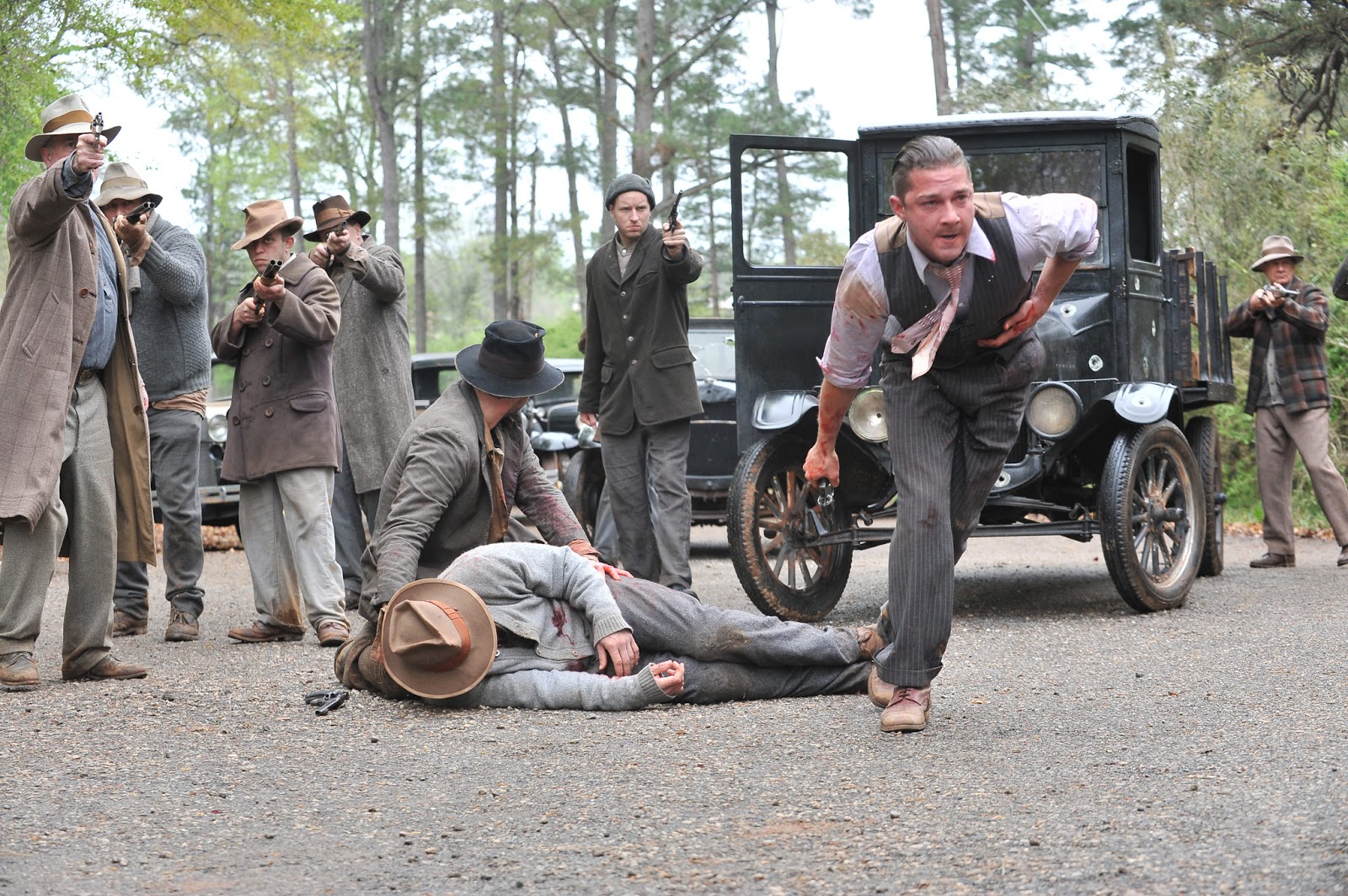
Shia LaBeouf and Tom Hardy lead in an all-star cast in John Hillcoat's late-summer gangster film, "Lawless."
Marvel's "The Avengers" may have kick-started summer 2012 with a bang thanks to its record-breaking $207.4 million debut but the season instead ended on a typically quiet note over Labor Day weekend as audiences largely stayed away from multiplexes. The last few weeks of August has always been used by Hollywood studios as a dumping ground for films with low box office prospects and this year was certainly no different. Closing out the summer is John Hillcoat's "Lawless," based on Matt Bondurant's 2008 historical novel The Wettest County in the World, which tells the tale of his grandfather and granduncles who ran a massive moonshining operation in the mountains of southwest Virginia during the tail-end of Prohibition in 1931. If you paid attention in history class, you should know that the United States government nationally banned the sale, manufacture, and transportation of alcohol through the Eighteenth Amendment to the Constitution, which was ratified in 1919 and put into effect a year later. However, the law proved to be immensely unpopular as it led to the growth of vast criminal organizations and was repealed fourteen years later in 1933 with the Twenty-First Amendment (the only instance in which an Amendment repealed another). The only good thing to have come out of Prohibition was the rise of the 'gangster film,' a subgenre that has continued to endure to this day. Given Hillcoat's pedigree with 2005's "The Proposition" and 2009's "The Road," you would think that The Weinstein Company would pick a better release date for "Lawless" instead of dropping it on the last week of summer. That's not a knock against the film and while "Lawless" may suffer from a flawed story, it remains a bloody, compelling piece of historical fiction backed up by an impressive ensemble cast. 

Set in 1931 during the Prohibition era, three brothers, Forrest (Tom Hardy), Howard (Jason Clarke), and Jack Bondurant (Shia LaBeouf), run a highly successful moonshining operation in a backwater town in Franklin County, Virginia, using their bar as a front for their illegal activities with the help of a cripple named Cricket Pate (Dane DeHaan). Selling to everyone in the county (including the police), the Bondurant Brothers are something of a local legend after oldest brother Howard returned from World War I as the sole survivor of a beach landing where the rest of his platoon drowned. Forrest contracted the flu with his parents but was the only one to recover, giving the locals the impression that they are 'indestructible.' While moving some boxes onto the family truck, Jack witnesses mobster Floyd Banner (Gary Oldman) gun down a competitor. Banner briefly makes eye contact with Jack and gives him a wink before he leaves. Meanwhile, a former dancer from Chicago named Maggie Beauford (Jessica Chastain) arrives at the Bondurant's bar looking for a job. Although uncomfortable around women, Forrest hires her as the new waitress. The Bondurant Brothers' way of life is soon threatened with the arrival of Special Agent Charlie Rakes (Guy Pearce) on behalf of the mayor, Mason Wardell. Rakes demands a cut of the Bondurant's profits but Forrest refuses and warns that he will kill him if he ever shows his face again. Meanwhile, Jack is tired of being just a driver and is desperate to play a more integral role in his brothers' operation so he can impress Bertha Minnix (Mia Wasikowska), the daughter of a local Mennonite preacher. As the other bootleggers give in to Rakes' violent intimidation tactics, the stubbornness of the Bondurant Brothers soon instigates a war that threatens to tear Franklin County apart. 

John Hillcoat's "Lawless" does not reinvent the gangster film but the script from Australian musician Nick Cave strikes an appropriately grim tone, drawing you into the story by exploring a number of interesting dichotomies. This is a tale of contrasts and at the forefront is the relationship between Forrest and Jack, who also serves as the film's occasional narrator. Both hold differing views on the use of violence and while Forrest may be a hulk of a man like his older brother Howard, he tends to hide his violent nature with his taciturn but soft-spoken demeanor. He even sports a cardigan like Mr. Rogers! However, Forrest understands the nature of the business he's in and when push comes to shove, he does whatever it takes to protect not only himself but also his family, always carrying a set of brass knuckles in his pocket. Violence and fear are powerful tools but he does not abuse them. Jack is the runt of the litter who shies away from getting his hands dirty. He can't even bring himself to kill a pig for dinner yet he runs around like a boy playing gangster, enjoying the fast cars and fancy clothes in an attempt to impress Bertha. It is only when Charlie Rakes comes knocking on his door that he finally understands what he must do. 

The Bondurant Brothers may be the protagonists but Hillcoat does not go out of his way to romanticize them and instead depicts the three as violent men who abide by a strict code of family honor. There's a certain bit of irony when Rakes is meant to enforce the law but resorts to sadistic means to get what he wants while the Bondurant's try to lead a quiet life despite their illegal activities. The violence is often brutal and stands in stark contrast to the idyllic, rustic setting of Appalachia. While it was filmed in Georgia, the production design from Chris Kennedy and the beautiful cinematography from Benoît Delhomme is quite convincing into making you think its shot in Virginia. "Lawless" does suffer from some flaws as its tangential subplots are woefully underdeveloped. Forrest's relationship with Maggie manages to produce some humorous moments and has some measure of depth but Jack's naïve romance with Bertha feels tacked on and adds little to the film other than to fill up the running time. Also, despite being the eldest Bondurant, Howard is never shown to be wrestling with any moral dilemmas and is simply presented as a raging brute. Floyd Banner appears in a grand total of three scenes, making his inclusion pointless. These issues are not enough to drag "Lawless" down but it does create a somewhat disjointed narrative where Hillcoat struggles with balancing its historical elements with other embellishments for the sake of drama. 

By far the best element of the film is the ensemble cast that Hillcoat has managed to assemble. Leading this cast is Shia LaBeouf, who has appeared in a number of summer blockbusters such as Michael Bay's critically-reviled "Transformers" trilogy and 2008's "Indiana Jones and the Kingdom of the Crystal Skull" but is now making a concerted effort to avoid big-budget studio filmmaking. Capturing Jack Bondurant's boyish naïveté and arrogance, LaBeouf delivers a surprisingly good performance and manages to hold his own against the likes of Hardy, Pearce, and Chastain. Compared to the eloquent Bane from "The Dark Knight Rises," Tom Hardy's Forrest is much more subdued, a man of few words who understands that violence is a necessity given their line of work yet exhibits a grandfatherly disposition as he silently sits outside the Bondurant's bar, acknowledging others with only a telling grunt. However, it is Guy Pearce who steals the film as Special Agent Charlie Rakes. With his well-oiled hair and effeminate voice, Rakes is by far one of the most despicable villains to grace the silver screen this year, with Pearce throwing himself into the role and chewing up the scenery with genuine relish. While his role amounts to little more than a cameo, Gary Oldman brings his A-game as the cocky Floyd Banner while Jessica Chastain exudes sex appeal as the mysterious Maggie Beauford, although her back-story feels like an afterthought. Mia Wasikowska and Jason Clarke are fine in their respective roles as Bertha Minnix and Howard Bondurant but the script gives them very little do. 

Released on August 29, 2012, "Lawless" received mixed reviews with 66% on Rotten Tomatoes. Critics noted that the film 'doesn't quite achieve the epic status it strains for, but it's too beautifully filmed and powerfully acted to dismiss.' It premiered at this year's Cannes Film Festival and competed for the prestigious Palme d'Or award but ultimately lost out to Michael Haneke's "Love." Despite business at the multiplex being slow as usual over Labor Day weekend, "Lawless" managed to eke out a $12.9 million debut over four days ($16.7 million so far) but the film was always going to be a tough sell given its period setting and subject matter. Hell, it played to a practically empty theater on a weekday afternoon, with a grand total of two people in the audience…and this was including me! "Lawless" may be a lesser effort from John Hillcoat due to its problematic script but the film's bleak tone, gorgeous visuals, and impressive cast more than make up for this, a fine capper to what has been an unpredictable summer.

Final Rating: 4 out of 5

"It is not the violence that sets men apart. It is the distance that he is prepared to go. Jack, look at me. We are survivors. We control the fear. But without the fear, we are all as good as dead."

Monday, September 3, 2012

The Possession Review

Rated PG-13 (Mature Thematic Material involving Violence and Disturbing Sequences)

Running Time: 1 Hour & 32 Minutes

Cast-
Jeffrey Dean Morgan-Clyde Brenek
Kyra Sedgwick-Stephanie Brenek
Natasha Calis-Emily Brenek
Madison Davenport-Hannah Brenek
Matthew Paul Miller/Matisyahu-Tzadok
Grant Show-Brett
Jay Brazeau-Professor McMannis
Ella Wade (voice)-The Dybbuk Abyzou

Directed by Ole Bornedal

Natasha Calis gives audiences the stare-down in "The Possession," the latest horror flick from Sam Raimi's Ghost House Pictures.

Adapted from the 1971 novel of the same name by William Peter Blatty, William Friedkin's 1973 horror masterpiece "The Exorcist" has remained the quintessential exorcism film for the last four decades and since then Hollywood has been releasing one knock-off after another in a futile bid to recapture lightning in a bottle. The latest attempt is Lionsgate's generically titled "The Possession" from Danish director Ole Bornedal and producer Sam Raimi, who is best known for helming the mega-blockbuster "Spider-Man" trilogy but is no stranger to the horror genre as his feature film debut was the 1981 cult classic "The Evil Dead." Like Luc Besson and Guillermo del Toro, Raimi has kept himself busy as a producer, although it's immediately clear that his involvement is limited due to his demanding schedule. Many of the horror flicks produced by Raimi via his company Ghost House Pictures have received overwhelmingly negative reviews with "Boogeyman," "The Grudge 2," and "The Messengers" all barely topping 10% on Rotten Tomatoes while 2009's "Drag Me to Hell," which he personally wrote and directed, managed to earn a surprisingly high 93% from critics. Does "The Possession" stand a chance at breaking the cycle of mediocrity that has plagued many Raimi-produced horror films? Unfortunately, the answer is no as "The Possession" fails to differentiate itself from similarly-themed exorcism fare despite some genuinely tense moments, and a pair of solid performances from Jeffrey Dean Morgan and Kyra Sedgwick. However, it is still one of the few better "Exorcist" knock-offs thanks to Bornedal's emphasis on drama over cheap thrills (although there is plenty of that too). 

Alone in her house, an old woman begins to hear whispers coming from a large wooden box. She initially tries to ignore it but cannot and attempts to force open the box using a hammer. However, the woman begins to age rapidly and even decompose before being violently thrown around the living room by an unknown force while her body painfully contorts. Meanwhile, university basketball coach Clyde Brenek (Jeffrey Dean Morgan) visits his ex-wife Stephanie (Kyra Sedgwick) after work to pick up his two daughters, Hannah (Madison Davenport) and Emily (Natasha Calis), for the weekend. Taking the girls to his newly-built house in a remote part of the suburbs, Clyde orders pizza for dinner despite Stephanie's chiding reminder to not let them eat anything unhealthy. However, Hannah upsets her younger sister's feelings by insisting that their parents will never be getting back together. Before putting her to sleep, Clyde and Emily bond by making shadow puppets. The next day, Clyde and his daughters stop at a neighborhood yard sale to buy some new dishes but Emily becomes intrigued by a strange wooden box engraved with Hebrew inscriptions. She begs her father to buy it for her and he happily complies. Back at home, Emily tries to open the box and asks her father for help but he is unable to open it either. There is clearly something inside but Clyde deduces that whoever built the box didn't want it to be opened. Emily is awakened by strange whispers while sleeping that night and finds herself drawn to the box, which she easily opens despite the difficulty earlier. Her obsession with the box continues to grow as the weeks go by, leading to wildly erratic mood swings and violent outbursts such as stabbing her father with a fork and lashing out at a classmate. Clyde begins to suspect that his daughter's change in behavior is connected to the box and discovers that it contains a dybbuk, a malevolent spirit that will stop at nothing to consume Emily's soul. 

"The Possession" is allegedly 'based on a true story,' although the 'story' that the film is based on is actually a 2004 newspaper article that appeared in the Los Angeles Times titled A Jinx in a Box? written by Leslie Gornstein, which followed a supposedly real dybbuk box that was sold on eBay. Ironically, the article warns that the urban legend 'contains a parade of red flags that point to a possible hoax' but Hollywood has always held a very loose definition on what constitutes a 'true story.' As a horror film, "The Possession" fails to offer much in the way of actual scares due to being constrained by its PG-13 rating, with the plot treading well-worn territory by relying on the same old clichés that audiences will have seen countless times already. The only element that approaches some originality is the inclusion of Jewish folklore but this is largely window dressing as the script from Juliet Snowden and Stiles White (the writing duo's previous credits include 2005's "Boogeyman" and 2009's "Knowing," both of which received negative reviews with 13% and 33% on Rotten Tomatoes) never goes out of its way to differentiate it from Christian folklore. Ole Bornedal is certainly a more competent director compared to Todd Lincoln (remember last week's "The Apparition"?) and builds a suitably creepy atmosphere that is sadly marred by some haphazard editing as scenes often end abruptly or fade to black. Even Anton Sanko's score grows tiresome when you hear the same piano notes for the umpteenth time. Still, there are a few tense moments scattered throughout the film, including a threatening conversation between the dybbuk and a terrified Emily on a darkened stretch of road. The sole streetlight positioned in the background in that scene recalls the famous poster from "The Exorcist", which I'm sure is no coincidence since Bornedal cited it as one of his inspirations in an interview. The marketing campaign also used a similar poster design to Friedkin's film but it reinforces just how unoriginal the exorcism subgenre has become. "The Possession" actually works better as a drama, exploring the effects a divorce can have on children and grounding the characters in a relatable manner. However, this is pushed aside as the film wears on in favor of more cheap scares and the big climax collapses on itself when a rabbi named Tzadok (Matthew Paul Miller/Matisyahu) performs the exorcism while wearing a ridiculous shawl and shouting in Yiddish. What's ultimately disappointing about "The Possession" is that the film brims with potential but Bornedal never fully takes advantage of its ideas and is content with playing it safe. 

In spite of the numerous clichés plaguing the film, the cast manages to deliver solid performances. The standout is definitely thirteen-year-old Natasha Calis, who melts into her role completely as a sweet innocent girl slowly falling apart at the seams, unaware that an evil spirit seeks not only to control but to also consume her very soul. Many of the best scares can be attributed to Calis and while her performance is not quite on Linda Blair's level, it comes damn close. Jeffrey Dean Morgan is endearing as a father trying to put his life back together after a protracted divorce but finds himself caught up in forces he does not completely understand. Some cheesy dialogue notwithstanding, the desperation etched on Morgan's face paints a sympathetic picture that all fathers can relate to. Kyra Sedgwick (from TNT's now-completed "The Closer") is fine as Clyde's ex-wife Stephanie but her character is not as compelling compared to Calis and Morgan's, her uptight nature sometimes approaching a caricature. Finally, there's reggae/hip-hop artist Matthew Paul Miller, better known by his stage name Matisyahu, as a young rabbi named Tzadok who agrees to assist Clyde in exorcising the spirit residing in his daughter. 

Released on August 31, 2012, "The Possession" has received largely negative reviews with 35% on Rotten Tomatoes. Critics noted that 'it may be based on a true story, but that doesn't excuse the way [the film] repeatedly falls back on hoary ghost movie clichés—or the unintentional laughs it provides.' Still, it can't be worse than sitting with one of the most unruly audiences I've ever encountered during an advance screening last Thursday. Disruptive and inconsiderate, I'm actually willing to pay more so that theaters can hire employees that can 'screen out' noisy patrons and ban them, leaving us to watch our film in peace. Alas, such a notion only exists in our minds. The Labor Day weekend is one of the slowest of the year for movies but "The Possession" managed to scare up an estimated $17.7 million, already making back its production budget of $14 million. The only competition was John Hillcoat's "Lawless," which came in at a distant second with $9.7 million. While the film is backed up by solid performances and is competently directed by Ole Bornedal, "The Possession" ends up being another mediocre horror film that is not only limited by its PG-13 rating but also fails to take any risks, relying on the same old clichés that have existed for the past four decades. You're better off just watching "The Exorcist" again.

Final Rating: 2.5 out of 5

"Daddy, you scared me…"