Sunday, April 15, 2012

The Cabin in the Woods Review

Rated R (Strong Bloody Horror Violence and Gore, Language, Drug Use and some Sexuality/Nudity)

Running Time: 1 Hour & 35 Minutes

Cast-
Chris Hemsworth-Curt Vaughan
Kristen Connolly-Dana Polk
Anna Hutchison-Jules Louden
Fran Kranz-Marty Mikalski
Jesse Williams-Holden McCrea
Richard Jenkins-Richard Sitterson
Bradley Whitford-Steve Hadley
Brian White-Truman
Amy Acker-Wendy Lin
Tim De Zarn-Mordecai
Sigourney Weaver-[Redacted]

Directed by Drew Goddard

You think you know the story...think again.
Note: I have done my best to avoid spoilers but reading this review will reveal the ideas behind what the film is about without pointing toward any specific scenes.

I always get a number of different responses when I tell people that I review films as a hobby. Some are merely curious about why I do it while others derided it as a huge waste of time but as posted on my best friend’s Facebook profile, ‘time you enjoy wasting, was not wasted.’ Writing film reviews is certainly no easy task and goes beyond stating whether you like or dislike a movie. Active attention must be paid to every film that you are watching so that when you sit down to write the review, you have enough detail to backup your opinions in an articulate and coherent manner. The real difficulty with writing film reviews is in how much you reveal to the reader. This is the dilemma I face with “The Cabin in the Woods,” a horror film written by Joss Whedon and Drew Goddard, who also serves as director. Although completed in 2009 with a release date set in 2010, the film unfortunately languished on the shelf for two years due to the financial troubles faced by distributer MGM, who are now recovering from Chapter 11 bankruptcy. Finally released into theaters courtesy of Lionsgate, “The Cabin in the Woods” may just be one of the most brilliant horror films I’ve ever seen. Whedon and Goddard have crafted something that not only serves as a love letter to the genre but also deconstructs every element in a manner that is funny, clever, and most importantly, original.

The film opens with a series of puzzling cave images depicting various cultures committing blood sacrifices throughout history. Fast forward to the present day, we find Curt Vaughan (Chris Hemsworth) and his girlfriend Jules Louden (Anna Hutchison), with their friends Dana Polk (Kristen Connolly), Marty Mikalski (Fran Kranz), and Holden McCrea (Jesse Williams), packing their bags for a weekend away at a remote cabin that was recently purchased by Curt’s cousin. Elsewhere at an undisclosed underground location, two ordinary-looking scientists named Richard Sitterson (Richard Jenkins) and Steve Hadley (Bradley Whitford) is observing the five college students as they travel to the cabin for purposes unknown. Curt and his friends make it to the cabin safely but as the night wears on, it soon becomes increasingly clear that they are not alone and that something is lurking in the woods. 

“The Cabin in the Woods” is a film that is best viewed without any knowledge in advance and I will do the best I can to avoid spoilers because much of the film’s enjoyment comes from the numerous surprises it has to offer. This is a film based on deception and it fools you by offering up one of the most generic horror premises of all: a group of college friends go to the cabin in the woods to enjoy a weekend of debauchery. Countless horror films have dealt with such a premise before but then Whedon and Goddard begin to turn the tables on the audience by slowly subverting established clichés while you’re left wondering just what the heck the two scientists in the underground bunker have to do with anything. Rest assured that the writers have a clear vision in their mind and execute it with aplomb. The film also gleefully satirizes and comments on how far the horror genre has come over the past one hundred years and there are numerous nods to various horror films from “The Wolfman” to even “Hellraiser.” Some of the references might be too obscure but for everyone who fancies themselves a fan of the genre, it offers up a level of participation from the audience that is unheard of, allowing the film to explore places without fear of ridicule. If this sounds awfully vague, I apologize in advance but it is for your own good. Classic character archetypes and conventions are deconstructed but not in a way that Wes Craven accomplished for his “Scream” films. The characters in Goddard’s film are not aware of their situation like we are and this creates a situation where they are being watched for the enjoyment of others ala “The Truman Show,” revealing that much of the appeal of horror is in watching others slowly suffer. What is really amazing is that the writers succeed in balancing two conflicting tones and create something that is both funny and serious at the same time. Despite being marketed as a conventional horror film, none of what happens is particularly scary or shocking but it does deliver on the blood and gore, especially during the final twenty minutes. 

When “The Cabin in the Woods” was being filmed back in 2009, all of the cast were unknowns but Chris Hemsworth has come a long way. He was James T. Kirk’s father in J.J. Abrams’ 2009 reboot “Star Trek” and now stars as the Norse God of Thunder in 2011’s “Thor” and the upcoming film “The Avengers,” ironically directed by Joss Whedon. The rest of the cast aren’t as recognizable but all of them, including Hemsworth, portray their characters in a convincing manner. The fact that they are being manipulated by forces out of their control helps you sympathize with them as they attempt to fight back and survive. Richard Jenkins and Bradley Whitford play the two scientists residing in the underground bunker whose sarcastic back-and-forth banter provides a lot of laughs to lighten the mood. Sigourney Weaver even pops up to make an appearance at the end but to reveal her role would spoil the entire film. 

Released on April 13, 2012, “The Cabin in the Woods” has received overwhelmingly positive reviews with 93% on Rotten Tomatoes. Critics hailed it as ‘an astonishing meta-feat, capable of being funny, strange, and scary—frequently all at the same time.’ The audience I saw the film with thoroughly enjoyed it as well judging from the comments that I overheard and I foresee the film becoming a cult classic the future. It’s astonishing how a film that was shelved for two years could turn out to be so brilliant and clever. The film is expected to land in third place with an opening weekend debut of $15 million, which is fine but nothing spectacular. Although many have proclaimed their love for the film, some have already started to deride it due to feeling cheated by the marketing in a situation similar to last year’s “Drive.” If that is the case, then this is the advertiser’s fault and not the film. I sure hope no one sues Lionsgate though! “The Cabin in the Woods” is a film that was one surprise after another. This is a horror film made by horror fans for horror fans and I urge you to run to the theater to see it now!

Final Rating: 4.5 out of 5

“I seriously believe something weird is going on!” (Ain't that the truth?!)

Saturday, April 14, 2012

Lockout Review

Rated PG-13 (Intense Sequences of Violence and Action, and Language including some Sexual References)

Running Time: 1 Hour & 35 Minutes

Cast-
Guy Pearce-Snow
Maggie Grace-Emilie Warnock
Peter Stormare-Scott Langral
Lennie James-Harry Shaw
Vincent Regan-Alex
Joseph Gilgun-Hydell
Tim Plester-Mace
Peter Hudson-President Warnock
Jacky Ido-Hock
Miodrag Stevanovic-Frank Armstrong

Directed by James Mather and Stephen St. Leger

"So this is what my career has come to."
French director Luc Besson has over fifty films to his credit either as director, writer, and/or producer in an impressive career that has now spanned three decades with no signs of stopping. Unfortunately, his recent work is anything but impressive as his factory-like studio EuropaCorp continuously churns out action films year after year and often recycles elements from Besson’s earlier films such as 1990’s “Nikita” and 1994’s “Léon: The Professional.” Keeping himself busy in the past twelve years as a writer and producer, Besson has only occasionally returned to the director’s chair to adapt his “Arthur” series of fantasy novels into a trilogy of animated films. His latest film, “The Lady,” based on the life of former Burmese political prisoner Aung San Suu Kyi starring Michelle Yeoh and David Thewlis, is currently in limited release but critical reception has been mixed. Besson and EuropaCorp’s latest collaboration is “Lockout”, a science fiction/action film that never rises above mediocrity thanks to its lazy script and generic visuals. 

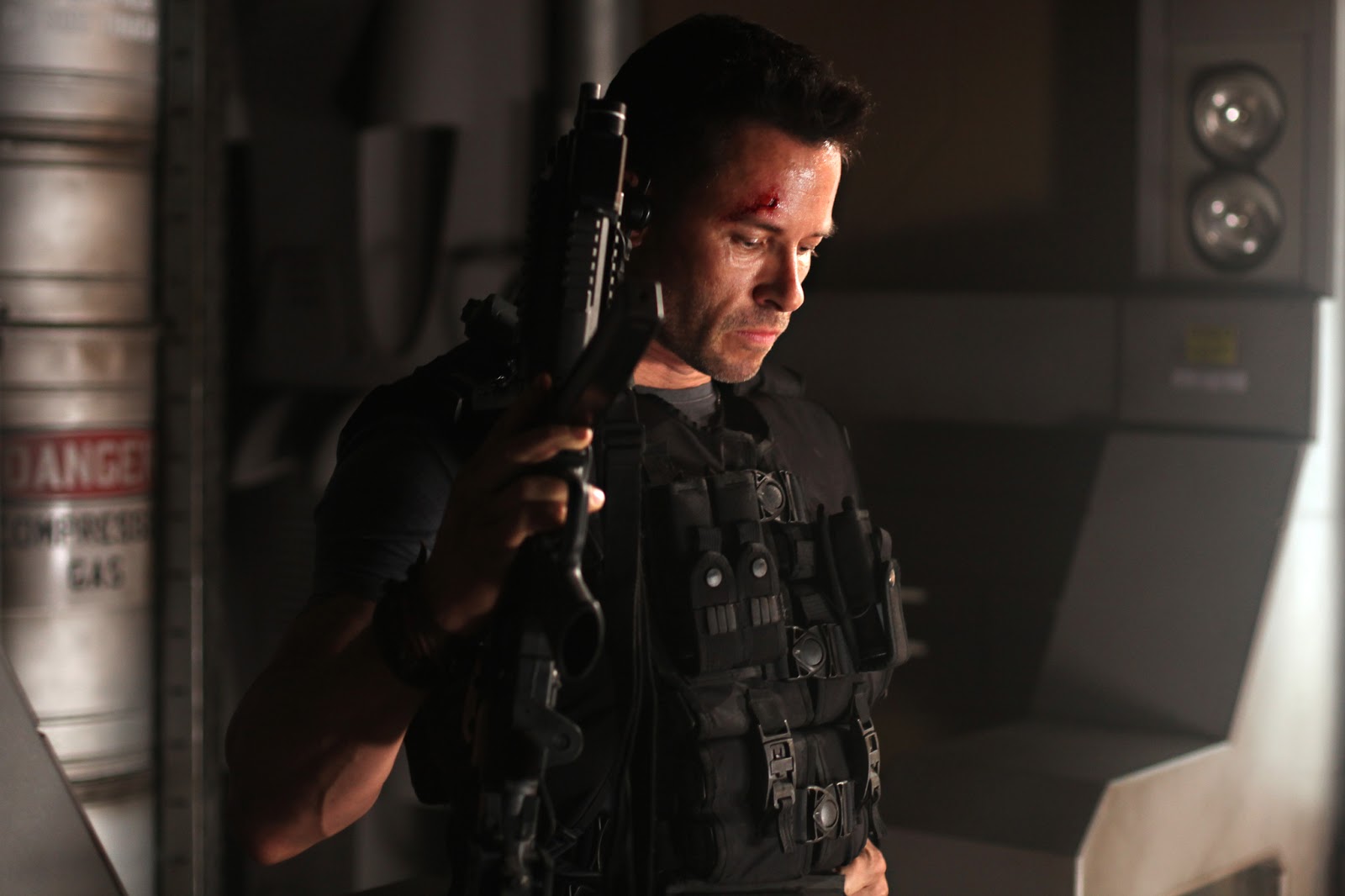
Taking place in the year 2079, an ex-CIA agent named Snow (Guy Pearce) has been captured for interrogation by Scott Langral (Peter Stormare), the Chief of the United States Secret Service. Snow is accused of shooting his best friend Frank Armstrong (Miodrag Stevanovic), who was supposedly trying to sell state secrets to a foreign power. Unable to get Snow to confess, Langral later informs him that he has been found guilty of murder and conspiracy to commit espionage against the United States and will be sentenced to thirty years of stasis sleep aboard the maximum security space prison MS-One. Meanwhile, Emilie Warnock (Maggie Grace), daughter of the President of the United States, has arrived on MS-One on a humanitarian mission to ensure that the prisoners have been treated fairly and study the effects of stasis sleep on their mental health. Emilie interviews a psychotic prisoner named Hydell (Joseph Gilgun) but he ends up grabbing her bodyguard’s gun and shoots out the protective window separating Emilie from him, causing a massive explosion. Hydell escapes from his chains and forces a technician to free all the prisoners in stasis, who quickly overwhelm all the guards and take over the space station. An intelligent inmate named Alex (Vincent Regan) assumes leadership over the other prisoners and takes the station’s staff, including Emilie, hostage. Langral informs President Warnock (Peter Hudson) of the situation, who orders a full-scale military assault but another Secret Service agent named Harry Shaw (Lennie James) suggests sending in one man to rescue Emilie. This man turns out to be Snow, who initially scoffs at the offer but changes his mind when Shaw subtly reveals that his contact Mace (Tim Plester) is aboard MS-One and can prove Snow’s innocence. With the massive space station on a crash course to Earth, Snow races against time to rescue Emilie and clear his name while battling hundreds of the world’s most violent and sadistic criminals. 

“Lockout” was a film that wasn’t even on my radar until I saw a preview of it during a screening of “Haywire” back in January. Judged solely on its poster, I wouldn’t be surprised if you mistook the film for some bargain bin, direct-to-video schlock because that’s honestly where it should belong. Lacking any sense of identity and imagination, the futuristic world that is presented in the film is generic to a fault and looks like a poor man’s version of 1982’s “Blade Runner.” Aside from an armored police hovercraft and extra grime in the streets, 2079 looks no different from 2012. Hell, even the subways in New York City remain unchanged, although I would imagine the fare hikes will be quite high given the rate of inflation but you would think a more efficient form of public transportation be developed sixty-seven years into the future. Written by Besson with directors James Mather and Stephen St. Leger, the script is predictable and offers no real surprises but what’s even worse is that these three cannot even take what is a relatively simple concept and turn it something exciting or suspenseful. Logic is thrown out the window as well with characters frequently going into dangerous locations marked with huge warning signs but no one ever notices until it’s too late! Even more puzzling is that this massive prison/space station has so few guards and no computer security system in place to lock out any unauthorized intruder. The ending is both anticlimactic and a rushed mess as the film sloppily ties-up every loose-end. Usually, a film of this type has at least a few standout action scenes to make up for its lack of story but none of the fights showcase anything new or compelling that we haven’t seen before. “Lockout” even rips-off of last year’s “Mission Impossible: Ghost Protocol” when Snow finds himself attacked by a prisoner in a large, anti-gravity chamber. The visual effects work range from competent to absolutely horrendous, especially during a chase scene in the beginning of the film that features obvious green-screen work. No one was expecting an award-winning film but it feels like Besson isn’t even trying. 

The characters are largely one-note with little in the way of personality but Guy Pearce seems to have a lot fun as Snow and really tries to elevate the film with his snarky, no-nonsense personality. His constant one-liners offer up a chuckle and Pearce remains the sole bright spot in an otherwise mediocre film but his efforts are ultimately wasted without a good (or at least competent) script to back it up. Maggie Grace is an attractive lady but she comes across as a whiny brat and the lack of any on-screen chemistry fails to justify their eventual romance. The rest of the cast do not even try to hide their boredom and do very little besides staring into a computer screen. It’s clear that Peter Stormare and Lennie James are only in the film to pick up a paycheck and call it a day’s work. With no discernible motivation, the villains fail to drum up any sort of menace with the exception of Joseph Gilgun as a mentally-unhinged prisoner named Hydell. 

“Lockout” was released on April 13, 2012 to largely negative reviews with 33% on Rotten Tomatoes as critics wrote it off as ‘ultimately too derivative and shallow to build on the many sci-fi thrillers it borrows from.’ This film was made on a production budget of approximately $20 to $30 million so it’s not like it was a huge investment for the studios involved. However, with only $2.2 million so Friday, it’s going to have to settle for a weak opening weekend debut of $6.5 million but the screening I was at almost had a packed audience to my surprise. “Lockout” may provide some mild thrills for those who have a penchant for B-movie genre fare but for everyone else, you might as well go check out “The Hunger Games” for the fourth time…unless you’d prefer that horrid comedy “The Three Stooges” from the Farrelly Brothers.

Final Rating: 2 out of 5

“Don't get me wrong. I mean, it's a dream vacation! I mean, I go into space…I get inside the maximum security nuthouse. Get past all the psychos, save the President's daughter, if she's not dead already. I'm thrilled that you would think of me.”

Monday, April 9, 2012

American Wedding Unrated Blu-Ray Review

Unrated (Sexual Content, Language and Crude Humor)

Running Time: 1 Hour & 43 Minutes

Cast-
Jason Biggs-James ‘Jim’ Levenstein
Thomas Ian Nicholas-Kevin Myers
Eddie Kaye Thomas-Paul Finch
Seann William Scott-Steve Stifler
Alyson Hannigan-Michelle Flaherty
January Jones-Cadence Flaherty
Deborah Rush-Mary Flaherty
Fred Willard-Harold Flaherty
Eric Allan Kramer-Bear
Eugene Levy-Jim's Father/Mr. Levenstein
Jennifer Coolidge-Stifler's Mother
Amanda Swisten-Fraulein Brandi
Nikki Schieler Ziering-Officer Krystal

Directed by Jesse Dylan

It's about time these two tied the knot!
Wedding scenes in movies have always made me smile but that still wasn’t enough to save 2003’s “American Wedding”, the third and supposedly final installment in the mediocre yet popular “American Pie” franchise. The arrival of another sequel does not come as any real shock to anyone since the first and second films have earned a nice tidy sum of $235 and $288 million worldwide each, which may not seem like much but the relatively cheap production budgets has allowed Universal to rake in the dough. The original “American Pie” led to a renewed interest in the R-rated sex comedy when it was released in 1999 with some fans even hailing it as an instant classic and comparing it to 1982’s “Porky’s”, a film that was much maligned by critics upon release and was on Roger Ebert and Gene Siskel’s ‘worst of the year’ lists. Whether you liked Paul Weitz’s film or not, one thing was perfectly clear—it was by no means an ‘instant classic’, two words that audiences liberally misuse too often. The surprise financial success of “American Pie” led to a sequel in 2001 but it was clear from the onset that “American Pie 2” was made without an ounce of inspiration or even wit and existed solely to cash-in on the audience goodwill generated from the original film. “American Wedding” faces the same predicament and while this third entry is a slight improvement over the previous film, many of the problems that have existed since its inception remain unfixed. The main story continues to go nowhere for much of its running time in favor of even more ridiculous antics that reek of desperation and the expanded role for Seann William Scott’s Steve Stifler prove to be a major miscalculation as the character is too much of an unsympathetic a**hole to be taken seriously. 

Three years have passed since the events of the previous film and not wasting any time after graduating from college, James ‘Jim’ Levenstein (Jason Biggs) decides to propose to his girlfriend Michelle Flaherty (Alyson Hannigan) while dining at a fancy restaurant but shockingly discovers that he had left the ring at home. His ever-dependable father (Eugene Levy) calls his son that he is coming to his rescue but Michelle misinterprets Jim’s intentions and performs fellatio on him under the table. He is literally caught with his pants down once again by his father but despite the public embarrassment, Michelle happily agrees to Jim’s marriage proposal without hesitation. He promises her that their wedding will be perfect but he secretly confides with his two best friends, Kevin Myers (Thomas Ian Nicholas) and Paul Finch (Eddie Kaye Thomas), that he is worried that it will be a disaster due to his bad luck. Although not invited, the obnoxious Steve Stifler (Seann William Scott) unceremoniously crashes the engagement party, making a fool out of both himself and Jim in front of Michelle’s parents, Mary and Harold Flaherty (Deborah Rush and Fred Willard). Stifler reveals that he can teach Jim to dance but will only do so on the condition that he be allowed to attend the wedding and plan the bachelor party. Meanwhile, Paul tags along with Michelle to pick up her younger sister Cadence (January Jones) at the airport and is immediately attracted to her. However, Stifler is attracted to her as well and each adopts the personality and the mannerisms of the other in an effort to win Cadence’s affections. Jim struggles to keep the two from ruining the wedding while proving to Michelle’s parents that he is a good husband and the right man for her. 

One of the reasons why “American Pie 2” critically flopped as a sequel was that there were too many extraneous characters taking up screen-time but writer Adam Herz wisely avoids this by trimming much of the fat out for “American Wedding.” Another issue was the main story being given so little attention to the point of being an afterthought due to the inconsequential subplots that took up a huge chunk of the previous film’s running time. There is only one subplot in the third film but once again Herz makes the same mistake of devoting too much time toward it. While Jim is trying hard to give the perfect wedding to Michelle, Stifler is running around trying to sleep with her younger sister Cadence. Much of the comedy is running on leftover fumes at this point and instead of coming up with something new, Herz expands Stifler’s role even further and throws him into one ridiculous situation after another in a desperate bid to generate laughs. For Jim’s surprise bachelor party, Stifler invites two buxom strippers named Fraulein Brandi (Amanda Swisten) and Officer Krystal (Nikki Schieler Ziering) but the whole sequence is a painful drag and is little more than an excuse to display two pairs of surgically-enhanced breasts. At least it’s not as god-awful as seeing Chris Klein attempt phone sex and rubbing his nether regions. 

Later in the film, Stifler is giving the Flaherty’s dogs sausage treats but accidentally feeds them Jim’s engagement ring and forcing him to wait for the dogs to pass it out since he was entrusted to keep the ring safe. He manages to retrieve the ring by picking up a piece of dog feces with a napkin but Michelle’s mother mistakes it for a truffle and asks to have a taste. Stifler instead puts the dog feces in his mouth! First off, this act of coprophagia shows that nothing is off limits in the name of comedy but the second thing is that it makes no logical sense for the dog feces to be mistaken for a truffle. The foul odor should’ve been a dead giveaway and points to how forced many of the comedy set-ups feel. Herz then tries to humanize Stifler by having Cadence fall in love with him but it doesn’t work because he’s such an unsympathetic character to begin with. The only time I laughed was during the cold open but even that is recycled from the previous films. The rest of “American Wedding” is just one unfunny sequence after another at it limps along to the end credits. What little drama found in the film is hastily and conveniently resolved but the scenes where Jim’s father gives marriage advice to his son and later his would-be wife are well-done. Having him explain to Michelle that love is about compromise and sacrifice represents the series’ most honest moment and if Herz could’ve just took a step back and treated his characters like the adults they actually are, it would’ve improved the film. The wedding thankfully ends the film on a high note but it’s still a case of too little too late given what we had to suffer through. 

Chris Klein is conspicuously absent from this entry so the biggest weak link in the acting is thankfully gone and the rest of the cast slip into their roles comfortably. Jason Biggs and Alyson Hannigan make for an appealing on-screen couple because their character’s personalities complement each other so well. Thomas Ian Nicholas and Eddie Kaye Thomas are on hand to provide some familiar faces but their roles don’t really amount to much. As for Seann William Scott…I will concede that he plays the obnoxious a**hole well but Stifler works only in small doses like in the first film as having him in every scene just gets grating on the nerves. Not helping matters is his incessant whiny voice. January Jones (before she became an ice queen bitch) provides a pretty face as the pretty but bland younger sister of Michelle. The ever-dependable Eugene Levy remains as one of the few bright spots in the series and it was great to see him paired up with Fred Willard. 

“American Wedding” was released on Blu-Ray back in March to promote the upcoming release of “American Reunion” but the video quality is a step back from the previous film. Colors are vibrant and bold but skin tones often take on a jaundiced yellow or flushed red. Background details also look murky and lack depth but shadows look surprisingly pleasing to the eye. Audio is a step up with strong bass being utilized for many of the licensed songs and ambience for crowd scenes such as the dance-off between Stifler and an imposing man nicknamed Bear (Eric Allan Kramer) at a gay bar. Don’t ask me how that came about because the details are totally contrived and not worth mentioning. Many of the special features are useless but the two audio commentaries should prove to be an interesting listen. One has director Jesse Dylan and Seann William Scott while the other has Jason Biggs, Alyson Hannigan, Eddie Kaye Thomas, and Thomas Ian Nicholas. 

Released on August 1, 2003, “American Wedding” received mixed reviews with 55% on Rotten Tomatoes. Critics noted that it was ‘raunchier and even more gross than the first two [films and that it] ought to please fans of the series.’ The film was a box office success (of course) and earned $231 million worldwide but the production budget was noticeably higher at $55 million. This was supposedly the final film in the series but we all know that it isn’t over until Hollywood squeezes every last dime out of a franchise. The “American Pie” named was used in four spin-off films that had nothing to do with anything other than providing Eugene Levy with a steady paycheck and diluting the brand. While there are some scenes that manage to recapture the tone of the original film, “American Wedding” never rises above mediocrity because there is never any attempt to fix the problems that have existed since the series’ inception. The ‘bigger is better’ mentality hurts the film and Stifler’s boorish antics are afforded too much screen-time but if you’re already a fan, you’ll just disregard this review anyway.

Final Rating: 2.5 out of 5

“But boning aside, I think they call it making love because you have to make love work. You know, it's about compromise and sacrifice and I think Jim has sacrificed for you.”

American Pie 2 Unrated Blu-Ray Review

Unrated (Strong Sexual Content, Crude Humor, Language and Drinking)

Running Time: 1 Hour & 51 Minutes

Cast-
Jason Biggs-James ‘Jim’ Levenstein
Chris Klein-Chris 'Oz' Ostreicher
Thomas Ian Nicholas-Kevin Myers
Eddie Kaye Thomas-Paul Finch
Seann William Scott-Steve Stifler
Alyson Hannigan-Michelle Flaherty
Tara Reid-Victoria 'Vicky' Lathum
Mena Suvari-Heather
Shannon Elizabeth-Nadia
Natasha Lyonne-Jessica
Chris Owen-Chuck Sherman
Eugene Levy-Jim's Father/Mr. Levenstein
Casey Affleck-Tom Myers
Jennifer Coolidge-Stifler's Mother

Directed by J.B. Rogers

I'm sure they can reattach it, son.
Here’s a funny anecdote: I stupidly believed that ATM’s would automatically start spitting out money when the clock struck 12:00 AM on December 31, 1999 due to the Y2K computer bug. Fortunately (or unfortunately depending on your point of view), there was no major technological catastrophe and any problems that occurred on January 1, 2000 proved to be minor. Many have complained that the problem was grossly exaggerated and that ultimately, there was nothing to worry about but even so, I always say that it’s better to err on the side caution. Y2K was big news back in 1999 but so were movies thanks to a number of high-profile releases and breakout hits, one of which was Paul Weitz’s “American Pie.” R-rated sex comedies featuring copious amounts of nudity are nothing new in Hollywood but Weitz’s film led to a revival and the creation of a new successful franchise. “American Pie” lit up the summer of 1999 to the tune of $235 million worldwide (twenty times its production budget) and prompted Universal to green-light a sequel for release in 2001. The original “American Pie” was no classic by any definition and was honestly a thoroughly mediocre affair despite the fond memories that people have of the film. Not surprisingly, the lazily named “American Pie 2” is an uninspired sequel that is simply content with recycling everything from the original, including its problems. The comedy is even more ridiculous this time around but a majority of them aren’t even funny and the story once again goes nowhere due to having so many unnecessary characters that have little to do other than eat into the running time. How this series enjoyed such a positive reception continues to puzzle me. 

After finishing their first years at college, best friends James ‘Jim’ Levenstein (Jason Biggs), Chris 'Oz' Ostreicher (Chris Klein), Kevin Myers (Thomas Ian Nicholas), and Paul Finch (Eddie Kaye Thomas) reunite at East Great Falls, Michigan to spend the summer together. Unable to let go of his lingering feelings for his high school girlfriend, Victoria 'Vicky' Lathum (Tara Reid), Kevin confides in his older brother Tom (Casey Affleck), who advises him to rent the lake house at Grand Harbor and throw a memorable party at the end of their vacation. Kevin invites all his friends to come but is forced to have the obnoxious Steve Stifler (Seann William Scott) tag along in order to cover the rent for the house. The five manage to find temporary work as decorators and painters while dealing with their own personal predicaments. Oz tries to keep his relationship with Heather (Mena Suvari) alive while she is studying abroad in Spain by engaging in phone sex but finds himself continuously interrupted. Paul begins practicing the sexual art of Tantra in the hopes of sleeping with Stifler’s mother (Jennifer Coolidge) again while Steve becomes obsessed with a pair of female neighbors whom he suspects to be lesbians. Jim learns that Nadia (Shannon Elizabeth) will be visiting by the end of the summer and seeks sexual advice from band camp geek Michelle Flaherty (Alyson Hannigan). However, the two begin to develop feelings for each other as they spend more time together. 

“American Pie” featured a rather thin premise but the sequel’s nonexistent story plainly illustrates that this film was made solely to cash-in on the audience’s good-will for the original. Instead of losing their virginity, the main plot concerns Jim’s growing feelings for Michelle but this is given so little attention to the point of being an afterthought due to the inconsequential subplots that take up a huge chunk of the film’s running time. Many of the supporting characters have little to do other than to provide a familiar face in the mix and the constant allusions to the first film rob this one of any sense of real identity. Writer Adam Herz’s lack of inspiration shows when he not only recycles story elements of the original but even the comedy as well. Sophomore director J.B. Rogers embraces a ‘bigger is better’ mentality in an attempt to do outdo the original but all of it comes off as desperation. The only time where I genuinely laughed is when Jim finds himself mistaken for a special-needs trombone player at Michelle’s band camp and is forced to perform for a massive audience while wearing clothes that are two sizes too small. All the gags are simply repeats with some variations such as Stifler getting a ‘golden shower’ instead of drinking beer mixed with semen or two nude women loudly making out with each other while everyone in the neighborhood accidentally listens in through the radio or walkie-talkie. The latter is also a blatant and cheap excuse to titillate the audience rather than coming up with something new or even actually funny. Jim even superglues his hand to his genitals while masturbating but this makes the film feel like an exercise in humiliation. One of the few strengths of the original was that the characters were sympathetic and likable even if their motivations were selfish but because there is no real development and thus no motivation, it’s hard to emotionally invest in what they’re going through considering that their problems are ultimately trivial. “American Pie 2” is proof that sequels made in response of the first film’s financial success are pointless and often creatively bankrupt but Hollywood continues to be thick-skulled and remain willingly blind. 

The acting remains a mixed affair with Thomas Ian Nicholas still his whiny self but nothing tops the god-awful scene where Chris Klein tries to have phone sex and begins rubbing his nether regions. I kid you not when I say that it was the stuff that nightmares are made of. Jason Biggs brings a sincere earnestness as Jim and it’s hard not to like him given his dorky nice-guy mannerisms. Eddie Kaye Thomas is fine as lovesick pseudo-sophisticate Paul Finch while Alyson Hannigan brings a smile to my face with her quirky line delivery. Eugene Levy reprises his role as Jim’s bumbling yet somehow hip dad and the film is always made better whenever he is on-screen to give some fatherly advice to his son. Unfortunately, these moments are all too rare. Seann William Scott continues to be a world-class jerk as Steve Stifler. His behavior feels like a hormone-addled fifteen-year-old teenager who has just seen female breasts for the first time in his life. Tara Reid, Mena Suvari, and Shannon Elizabeth make cursory appearances but ultimately do little in the film. 

“American Pie 2” was released on Blu-Ray back in March to promote the release of “American Reunion” and the results are definitely are step up from the previous film. Digital noise reduction is not as aggressively used and the overall look feels much more vibrant even though skin tones can lean toward an orange tinge. The opening scene looks terrible however but thankfully, the video quality does get better. Things on the audio front are also noticeably improved with the licensed music having a richer volume but ambience still leaves much to be desired. Special features include the prerequisite deleted scenes, gag reel, and four audio commentaries: first up is director J.B. Rogers with writer Adam Herz on the second, third is Jason Biggs, Mena Suvari, and Thomas Ian Nicholas, and lastly Eddie Kaye Thomas flies solo on the fourth. 

Released on August 10, 2001, “American Pie 2” received mixed reviews with 52% on Rotten Tomatoes. Critics noted that the film failed to ‘retain the freshness of the original, nor is it as funny.’ Part of the reason for the middling reception was that the sequel suffered from numerous reshoots with entire subplots excised in order to keep it light and casual. Of course, it financially outdid the original with an impressive $288 million worldwide against a still cheap $30 million production budget, leading to a third film to be released two years later. “American Pie 2” has only one funny scene and the rest of the film simply limps along for two hours with a thin story that goes nowhere. Film critic James Berardinelli said it best in his own review: ‘when a motion picture is the result of a financial impulse, not a creative one, this is often the unfortunate result’ but Hollywood (or the audience) never learns.

Final Rating: 2 out of 5

“My brother said by the end of the summer I'll get the big picture. And I see it. No matter what, times change, things are different. But the problem is…I don't want them to be.”

American Pie Unrated Blu-Ray Review

Unrated (Strong Sexuality, Crude Sexual Dialogue, Language and Drinking, All Involving Teens)

Running Time: 1 Hour & 36 Minutes

Cast-
Jason Biggs-James ‘Jim’ Levenstein
Chris Klein-Chris 'Oz' Ostreicher
Thomas Ian Nicholas-Kevin Myers
Eddie Kaye Thomas-Paul Finch
Seann William Scott-Steve Stifler
Alyson Hannigan-Michelle Flaherty
Tara Reid-Victoria 'Vicky' Lathum
Mena Suvari-Heather
Shannon Elizabeth-Nadia
Natasha Lyonne-Jessica
Chris Owen-Chuck Sherman
Eugene Levy-Jim's Father/Mr. Levenstein
Casey Affleck-Tom Myers
Jennifer Coolidge-Stifler's Mother

Directed by Paul Weitz

Feels just like the real thing!
R-rated comedies have come a long way over the past ten years and are now more popular than ever with their relatively low production cost and potential for huge box office returns. Directed by Todd Phillips, 2009’s “The Hangover” ended up grossing a massive $467 million worldwide against a cheap $35 million production budget and its 2011 sequel made even more with $581 million despite being panned by critics (audiences didn’t seem to care). Not surprisingly, Phillips is planning to helm a third film. The comedy subgenre has also enjoyed critical acclaim with last year’s “Bridesmaids” receiving two Academy Award nominations for Best Supporting Actress and Original Screenplay. Although winning was never in the cards (the Academy is just too biased), this acknowledgement is still noteworthy. R-rated comedies are nothing new but the subgenre fell out of favor until 1999’s “American Pie” led to a revival. That year also saw a number of high-profile releases that included George Lucas’ long-awaited prequel “Star Wars Episode I—The Phantom Menace”, the Wachowski Brothers’ groundbreaking science fiction film “The Matrix”, and M. Night Shyamalan’s breakout supernatural thriller “The Sixth Sense.” Acclaimed director Stanley Kubrick also passed away that year with his final film “Eyes Wide Shut” released posthumously. Riding a wave of hype during the summer of 1999 thanks to an extensive screening campaign on college campuses (which is being repeated for the fourth film), “American Pie” ended up grossing an impressive $235 million worldwide (against a measly $11 million production budget), leading to the creation of a widely successful comedy franchise that has now spawned three sequels along with four direct-to-video spin-off films. However, the intervening years hasn’t been exactly kind to “American Pie” and what was once considered to be pushing the envelope thirteen years ago seems tame in comparison to the R-rated comedies of today. Despite the fond reputation it has garnered among fans, “American Pie” simply isn’t a very good film as it desperately tries to garner laughs from the audience with a series of increasingly ridiculous sex jokes that often fall flat while the story goes nowhere until the final twenty minutes where it engages in awkward moralizing. Fortunately, the characters remain a likable and even relatable bunch, making them the sole saving grace in this uneven comedy. 

With only three weeks left until their graduation, four best friends from suburban Michigan decide to make a pact to lose their virginity before they leave high school after a dorky classmate named Chuck Sherman (Chris Owen) claims to have lost his during a party hosted by the popular but obnoxious and vulgar Steve Stifler (Seann William Scott). James ‘Jim’ Levenstein (Jason Biggs) is enamored with an attractive exchange student from Czechoslovakia named Nadia (Shannon Elizabeth) and pursues her at the encouragement of his friends despite being socially awkward around women. However, he is forced to ask band camp geek Michelle Flaherty (Alyson Hannigan) to the prom after an embarrassing webcam incident online. Lacrosse player Chris ‘Oz’ Ostreicher (Chris Klein) decides to join the jazz choir club in an attempt to lose his reputation as an insensitive jock and find a girlfriend. He manages to win the affection of Heather (Mena Suvari) but their relationship is strained when she discovers Oz’s unsavory intentions. Meanwhile, Paul Finch (Eddie Kaye Thomas) pays a fellow classmate named Jessica (Natasha Lyonne) $200 to spread rumors of his sexual prowess around the school while Kevin Myers (Thomas Ian Nicholas) tries to take his relationship with Victoria ‘Vicky’ Lathum (Tara Reid) to the next level after being stuck in ‘third base’ for so long. Unfortunately, losing their virginity isn’t as easy as it sounds as each of them finds themselves in one ridiculous situation after another. 

The story in “American Pie” is as basic as they come and is little more than a skeletal framework for many of the outrageous events that occur throughout the film. Much of the material is rather tame despite its reputation as one of the raunchiest comedies ever made and although writer Adam Herz desparately tries to garner laughs from the audience, there simply aren’t many to be found. Just because the dialogue is loaded with f-bombs and various other vulgarities doesn’t mean it is automatically funny. There are some genuinely memorable moments including the infamous ‘apple pie’ and crazy webcam scenes (which reveal how far we’ve come in terms of technology) but that leaves much of the film spinning its wheels until the last twenty minutes when it realizes that there is still an actual story to tell. The four main characters go through a turning point and learn that there is more to life than losing their virginity but this last-minute moralizing feels rushed and insincere because this epiphany seemingly happens out of nowhere. “American Pie” does manage to capture the trials and tribulations faced by teenagers as they begin to transition into adulthood. The high school romances feel genuine as does the amiable relationship shared by Jim and his father. Unfortunately, too much time is spent on Jim’s friends and the film would’ve been better off focusing on one perspective instead of four at the same time. I find it puzzling that “American Pie” has enjoyed such a fond reception given its middling comedy and conventional plot but I believe much of its reputation stems from the fact that it tries to depict its characters as real people rather than as objects of humiliation (although that happens as well). Honestly, I feel Herz would’ve been better off writing a ‘dramedy’ instead of what we have here. 

The cast was made up of largely unknowns at the time with the exception of Alyson Hannigan (who was currently starring in Joss Whedon’s “Buffy the Vampire Slayer” on television) and veteran actor Eugene Levy. “American Pie” was Jason Biggs first lead role and he succeeds in capturing Jim’s good-natured awkwardness and easy excitability around sexually attractive women. The pseudo-sophisticate personality of Paul Finch fits Eddie Kaye Thomas like a glove but Thomas Ian Nicholas and Chris Klein do not fair so well. Nicholas often comes across as whiny and Klein is an absolute disaster with his slow line delivery. Seann William Scott founded his entire career on Steve Stifler, who comes off as a total a**hole with his annoying smirk but what do I know? Audiences seemed to have responded well to him because his role increased in the sequels. The female cast members appear to have been chosen based solely on their looks. Shannon Elizabeth is only famous for her extensive nude scene while Alyson Hannigan has far too little screen-time. Eugene Levy, however, excels with his deadpan delivery and deserves to be in the film more. The acting never rises above competent and is sometimes god-awful, leaving little mystery as to why the cast (with the exception of Hannigan once again) faded into relative obscurity. 

“American Pie” was released on Blu-Ray back in March to hype up the upcoming release of “American Reunion.” Strangely, it will be re-released later this summer to celebrate Universal’s 100th anniversary. I doubt anything will change so avoid double-dipping. While the picture is definitely superior to the DVD, it appears that digital noise reduction was used as often times faces look unnaturally smooth. Colors look lackluster and blacks tend to lean toward the fuzzy side of the spectrum. Audio is adequate with sharp dialogue but fails to deliver any kind of oomph considering all the licensed music used. Special features are surprisingly impressive with a 3 hour and 33 minute making-of documentary on the entire trilogy. Director Paul Weitz, producer Chris Weitz, writer Adam Herz and cast members Jason Biggs, Sean William Scott and Eddie Kaye Thomas are on-hand for the audio commentary along with some promotional material on the fourth film. However, all of the extras are presented in standard definition. 

Released on July 9, 1999, “American Pie” received mildly positive reviews with 60% on Rotten Tomatoes but whether critics liked it or not didn’t matter as the film ended up being a box office success with $235 million worldwide ($322 million if adjusted for inflation). Two sequels followed in 2001 and 2003 but both received mixed reviews and the series limped on with four direct-to-video spin-offs that tarnished the brand further. “American Pie” may have been a big deal thirteen years ago but I feel audiences were simply caught up in the novelty of seeing a teen sex comedy after the sub-genre fell out of favor. Although the coming-of-age aspects of Herz's screenplay ring true, the film is just so desperate for laughs that the main story is little more than an afterthought with its rushed plotting and clichéd resolution. Outside of a few genuinely funny moments, much of the comedy is too juvenile and falls flat on its face. If you never bothered with the film, it’s unlikely you’ll like it now but fans will continue to love it just for nostalgia’s sake.

Final Rating: 2.5 out of 5

“I would like to make an announcement. There is a gorgeous woman masturbating on my bed!”

Monday, April 2, 2012

The Hunger Games Review

Rated PG-13 (Intense Violent Thematic Material and Disturbing Images—All Involving Teens)

Running Time: 2 Hours & 22 Minutes

Cast-
Jennifer Lawrence-Katniss Everdeen
Josh Hutcherson-Peeta Mellark
Liam Hemsworth-Gale Hawthorne
Willow Shields-Primrose Everdeen
Elizabeth Banks-Effie Trinket
Woody Harrelson-Haymitch Abernathy
Lenny Kravitz-Cinna
Wes Bentley-Seneca Crane
Stanley Tucci-Caesar Flickerman
Toby Jones-Claudius Templesmith
Donald Sutherland-President Coriolanus Snow
Alexander Ludwig-Cato
Isabelle Fuhrman-Clove
Leven Rambin-Glimmer
Amandla Stenberg-Rue
Dayo Okeniyi-Thresh
Jack Quaid-Marvel
Jacqueline Emerson-Foxface

Directed by Gary Ross

Katniss Everdeen, a heroine for the 21st century.
The turn of the twenty-first century saw reality television explode in popularity thanks to the early successes of “Survivor” and “Big Brother,” sparking a worldwide phenomenon that is now worth billions of dollars in advertising revenue. However, the ‘reality’ presented in these shows is nothing but a misnomer, an excuse for network executives and producers to create sensationalistic and often scripted events in order to attract viewers and drive up ratings. Shows like “Keeping Up with the Kardashians” and “Jersey Shore” create instant celebrities overnight but it appears that the bubble is about to burst as audiences grow tired of having so many programs competing for their attention. Still, millions of people around the world continue to tune in, which begs the question—why? What makes these shows so compelling even if the audience is keenly aware that what they are watching is not reality? Like the brutal gladiatorial battles of the Coliseum in Ancient Rome, society has always derived a certain perverse pleasure in watching others suffer or humiliate themselves for the entertainment of the masses. This forms the basic premise for the film “The Hunger Games,” based upon the popular 2008 dystopian science fiction novel of the same name from author Suzanne Collins. Director Gary Ross’ adaptation has been heavily anticipated by fans of the novel, with opening weekend tickets selling out like hot cakes while LionsGate looked to fill the void left behind by the “Harry Potter” films and soon “Twilight.” The only question that remains is whether it delivers upon the hype and despite a few hiccups in condensing a 384 page novel, “The Hunger Games” succeeds as not just an enthralling story of survival but also as a parable on the use of violent entertainment to keep the masses docile and under control. Fans should come away satisfied and newcomers will be encouraged to seek out the books. 

Following the destruction of North America due to an unspecified catastrophic event in the far future, the totalitarian nation of Panem—divided into thirteen districts under the regime of the Capital—rose from the ashes. However, District 13 rebelled against the Capital and was subsequently destroyed. As punishment for this insurrection, the Capital forced the remaining districts to participate in an annual event dubbed the Hunger Games where a boy and a girl ranging from ages 12 to 18 are selected by lottery to fight to the death in an undisclosed arena. Sixteen-year-old Katniss Everdeen (Jennifer Lawrence) lives in District 12 with her younger sister Primrose (Willow Shields) and widowed mother in a slum known as the Seam. Katniss often sneaks outside the district with her best friend Gale Hawthorne (Liam Hemsworth) to hunt for game and sell it for food. On the day of the reaping, all the children in the district are gathered to a large town square where one boy and girl will be randomly chosen by lottery as tributes for the 74th annual Hunger Games. A shrill, gaudily dressed woman named Effie Trinket (Elizabeth Banks) announces the first tribute to be Primrose Everdeen. To protect her younger sister, Katniss volunteers to take her place. The male tribute is Peeta Mellark (Josh Hutcherson), the son of a local baker who once gave Katniss food when she was starving in the rain. After saying their final good-byes to their respective families, the two are brought to the Capital where they will be trained by Haymitch Abernathy (Woody Harrelson), a former winner of the Hunger Games from District 12. Also on hand to lend advice and moral support is the flamboyant Effie and sympathetic stylist Cinna (Lenny Kravitz). Katniss becomes an early favorite thanks to her bold showmanship and skill with a bow, much to the delight of the viewers and Seneca Crane (Wes Bentley), the organizer for the Hunger Games. To get the audience on their side, Haymitch establishes Katniss and Peeta as ‘star-crossed lovers’ but the situation becomes complicated when genuine feelings begin to develop between them. 

Let me just say that I have read the novel; in fact I was so adamant on reading the book first that I refrained from seeing the film on opening weekend. Normally I shy away from young adult fiction but Suzanne Collins really does an excellent job at drawing you into this post-apocalyptic world thanks to a strong heroine at the center of the story. The question of whether the novel is better than the film or vice versa is ultimately a null point because both mediums of story-telling have their own strengths and weaknesses but having Collins adapt her own book is big plus because it gives a certain quality control over the film adaptation. The premise of “The Hunger Games” is not particularly original as Japan’s “Battle Royale” from 2000 is uncannily similar but the concept stretches as far back to 1987’s “The Running Man” starring Arnold Schwarzenegger, 1975’s “Death Race 2000,” to even 1982’s cult classic “Tron.” Science fiction has always been used as a way to present issues in society and the film functions as an indictment on the pleasure and thrill people derive from seeing others humiliate themselves as a form of mass media entertainment. Gary Ross perfectly captures the two extremes that exist in Panem with the impoverished districts forced to gather resources while the citizens of the Capital, dressed in gaudy fashion with ridiculous hairstyles, lead decadent lives where the Hunger Games are used not just as a form of punishment for rebelling but also as a way to keep the wealthy from focusing on the real issues. This is an allusion to how the emperors of ancient Rome kept the citizens content and deflected concern with how he ruled. The colorful clothes that the wealthy wear seem to be somewhat inspired by 1982’s “Blade Runner.” Dropping the first-person narrative of the novel, Ross and his writers are able to delve deeper into how the Games work, which is a welcome addition. The leader of the Capital, President Coriolanus Snow (Donald Sutherland) is shown to be a cunning man and there’s this great scene where he speaks to Seneca Crane of giving just enough hope to the districts only to crush it again year after year. The film also creates an unsettling feeling in seeing the tributes dressed up in costumes and paraded around to the cheers of the audience when they are essentially lambs being sent to the slaughter. 

Adapting a novel to a film can be tricky business and Ross does occasionally stumble with certain transitions feeling rushed even though the running time is 2 hours and 22 minutes long. However, he does smartly externalize Katniss’ inner monologue by having the exposition delivered through a running commentary like a sports game. Similar attempts can feel lazy (the news broadcasts in 2007’s “Spider-Man 3”) but here it makes sense. Certain omissions also leave character motivations vague and the romance subplot is not handled very well in the context of the film. The other tributes are simple caricatures that remain underdeveloped but this is also the fault of the novel as well. To give the film a raw realism, Ross utilizes the ‘shaky cam’ approach which is effective in the many extreme close-ups he uses but it also robs the violence of much of its impact due to the need to keep it PG-13. He does make up for it by focusing on the suspense factor as Katniss fights for her survival. Finally, the visual effects, though limited, prove to be underwhelming, especially when the ‘muttations’ show up. 

As the film is told from a third-person narrative, one thing that Ross had to get right was the casting of Katniss Everdeen and he couldn’t have picked a better actress in Jennifer Laurence. She not only perfectly captures her character’s strength and will to survive but also her vulnerability. Her scene where she mourns another tribute’s death left a lump in my throat. This is what a strong female protagonist means, not like that other girl from that other teen franchise. Josh Hutcherson may not have as much screen-time compared to Laurence but he exudes a likable charm and inherent goodness. Woody Harrelson makes for a less abrasive Haymitch while Elizabeth Banks and Stanley Tucci nail the haughty, clueless behavior of the Capital’s wealthy citizenry. Lenny Kravitz captures the calm sympathy of Cinna and finally there’s Donald Sutherland, whose role mainly serves as a tease for parts two and three. I also want to bring attention to Wes Bentley because he is rocking one awesome fire beard. 

“The Hunger Games” was released on March 23, 2012 to largely positive reviews with 85% on Rotten Tomatoes. Critics hailed it as ‘thrilling and superbly acted, [and that it] captures the dramatic violence, raw emotion, and ambitious scope of its source novel.’ The production budget was only an estimated $78 million but the film is already a major financial success with $152 million on opening weekend and a current worldwide total of $365 million. Even in its second week, interest remained high compared to new releases “Wrath of the Titans” and “Mirror Mirror.” LionsGate has mentioned that green-lighting the sequels will depend on the box office but they’re all but guaranteed. While the transition from novel-to-film left a few stumbling blocks, “The Hunger Games” remains a compelling film that is well-acted and suspenseful, even serving as a cautionary tale on the dangers of complacency through the use of violent entertainment. Not every fan will be satisfied but that just goes with the territory. The sequel cannot come soon enough.

Final Rating: 4 out of 5

“Hope—it is the only thing stronger than fear. A little hope is effective…a lot of hope is dangerous. A spark is fine…as long as it's contained.”

Saturday, March 31, 2012

Wrath of the Titans 3D Review

Rated PG-13 (Intense Sequences of Fantasy Violence and Action)

Running Time: 1 Hour & 39 Minutes

Cast-
Sam Worthington-Perseus
Rosamund Pike-Queen Andromeda
Toby Kebbell-Agenor
Édgar Ramírez-Ares
Bill Nighy-Hephaestus
Ralph Fiennes-Hades
Liam Neeson-Zeus
Danny Huston-Poseidon
John Bell-Helius

Directed by Jonathan Liebesman

Now where did I put that lightsaber...
First they released the KRAKEN…now it’s time to feel the WRATH! Released back in April 2010, director Louis Leterrier’s “Clash of the Titans,” a remake of the 1981 Ray Harryhausen-produced film of the same name, did not enjoy the warmest of critical receptions and single-handedly destroyed whatever good faith the audience had in 3D with its god-awful conversion. As for myself, I am in agreement that the 3D was terrible but I did find the overall film to be an enjoyable action-adventure romp. With a worldwide box office gross of $493 million, a sequel was a no-brainer and one was green-lit almost immediately after the release of Leterrier’s film. However, Leterrier stepped down as director to serve as executive producer and was replaced with Jonathan Liebesman, who helmed the absolutely horrid “Battle: Los Angeles” in 2011. While the original film had some semblance of personality, “Wrath of the Titans” offers up none, lacking either a compelling narrative or characters and instead favors loud, CG-driven action set-pieces that ultimately feel dull and hollow. This is a sequel that exists solely because its predecessor made money. 

Taking place ten years after the events of the first film, the demigod Perseus (Sam Worthington) now leads a simple life as a fisherman with his son, Helius (John Bell), from his recently deceased wife Io. He is visited by his father, Zeus (Liam Neeson), who warns Perseus that the god’s power are waning since the humans have stopped praying to them and that they won’t be able to hold the walls of Tartarus for long. Perseus cannot bear the thought of leaving his son and reluctantly declines Zeus’ offer for help. Traveling to the gates of Tartarus with his brother Poseidon (Danny Huston) and his son Ares (Édgar Ramírez), Zeus meets up with Hades (Ralph Fiennes) to ask for his help. However, Ares is revealed to be working for Hades and attacks both Zeus and Poseidon. To keep their immortality, Hades and Ares have made a deal with the titan Kronos to drain Zeus’ power to revive him. Various demonic creatures are released from the underworld, including a large Chimera which begins attacking Perseus’ fishing village. Strapping on his old sword and armor, he battles and manages to beat the Chimera but is severely wounded. Entrusting the care of his son to his fellow villagers, Perseus and his winged steed Pegasus travel to Queen Andromeda’s (Rosamund Pike) camp to ask her where he can find Agenor, the demigod son of Poseidon. Before succumbing to his wounds, Poseidon revealed to Perseus that his son is the only one able to locate the mysterious being called the ‘Fallen One,’ who holds the key to defeating Kronos. Agenor (Toby Kebbell) is actually a prisoner of Andromeda for trying to steal the crown jewels and only agrees to help when he receives a full royal pardon and his weight in gold. Together they set out to find this ‘Fallen One’ and free Zeus before Kronos breaks free from Tartarus to wreck havoc upon the world. 

“Wrath of the Titans” features a formulaic and paper-thin plot that appears to have been hastily cobbled together in a single afternoon and is a film made without any real energy or enthusiasm of any kind. Writers Dan Mazeau and David Leslie Johnson fill the script with themes of sibling rivalry and the search for a father’s approval, which are welcome ideas but they are never afforded any screen-time to explore them in a satisfactory manner and function as nothing more than window dressing for the film’s gargantuan action set-pieces. More thought was put into planning these action scenes with the story slapped on at the last-minute as an afterthought and leaving all the characters devoid of any real personality. They serve only to react to all the CG monstrosities they encounter along their journey and much of the dialogue is often drowned out by the variety of chaos that is happening on-screen. Nothing of importance is really said anyway so you won’t miss much. “Wrath of the Titans” raises the stakes by having Perseus fight for a better future for his son but the film never gives you a chance to really care about what is happening to anyone, leaving it a dull and hollow experience. Audiences will solely be interested in the action and while visually impressive, it is just more of the same. The Kraken has now been replaced with the mad titan Kronos, who is depicted to be a massive rock-like monster that spews lava. Giant Cyclops’ and a fire-breathing Chimera also make an appearance along with the famous Minotaur but his fight with Perseus disappoints due to the excessive ‘shaky cam’ that Liebesman utilizes. Fortunately, this is only limited to battles that involve two human combatants but some of the larger set-pieces still suffer from seizure-like editing. The only aspect that has been improved is the 3D. This is another post-conversion but a lot more thought and preparation certainly went into it compared to its predecessor, which suffered from terrible motion blur. Liebesman frames his scenes to maximize his usage of 3D with objects flying toward the screen and the aspect ratio even changes at one point to create the effect of a snake-like monster’s jaws covering up the black bars at the top and bottom of the screen. Seeing the camera zoom around the massive prison of Tartarus is stunning and though the 3D devolves into little more than a gimmick, it is at least used to its advantage. 

Due to its simplistic plot and overreliance on CG action, the cast resort to shouting all their lines. Sam Worthington may be a popular actor but his range continues to be limited as he spends the film either screaming in fury or in a constipated grimace. Still, he makes for a credible action hero. Replacing Alexa Davalos as Andromeda is Rosamund Pike but her inclusion seems to be just an excuse to have a female co-star as she does little other than swing a sword. Toby Kebbell serves as comic relief while Édgar Ramírez actually makes for a menacing god of war. Bill Nighy also makes an appearance as Hephaestus and continues his shtick of emphasizing every other word. Finally, there’s Liam Neeson and Ralph Fiennes, the only actors who come out of this film with their dignities unscathed. 

“Wrath of the Titans” was released in 2D, 3D, and IMAX 3D on March 30, 2012 to overwhelmingly negative reviews with 24% on Rotten Tomatoes. I may have liked the first film but this time I’m inclined to agree with the critics, who found the 3D effects ‘an improvement over its predecessor's, but in nearly every other respect [the film] fails to improve upon the stilted acting, wooden dialogue, and chaos-driven plot of the franchise's first installment.’ Audience attendance was middling and the film is looking to finish the weekend behind “The Hunger Games” with $30 to $35 million, a far cry from its predecessor’s $61.2 million. If I was younger, I would’ve loved “Wrath of the Titans” but now I’m older and a bit more discerning about my taste in film. Thanks to the almost non-stop action, this sequel is never boring nor is it an outright terrible film but it ultimately leaves you feeling hollow inside.

Final Rating: 2.5 out of 5

“You will learn someday that being half human, makes you stronger than a god.”