Thursday, November 26, 2009

Godzilla (1998) Blu-Ray Review

Rated PG-13 (Sci-Fi Monster Action/Violence)

Running Time: 2 Hours & 19 Minutes

Cast:
Matthew Broderick-Dr. Niko Tatopoulos
Jean Reno-DGSE Agent Philippe Roaché
Maria Pitillo-Audrey Timmonds
Hank Azaria-Victor 'Animal' Palotti
Kevin Dunn-Colonel Hicks
Harry Shearer-WIDF Anchor Charles Caiman
Doug Savant-Sergeant O'Neal
Arabella Field-Lucy Palotti
Michael Lerner-Mayor Ebert
Vicki Lewis-Dr. Elsie Chapman
Malcolm Danare-Dr. Mendel Craven
Chris Ellis-General Anderson

Directed by Roland Emmerich

Godzilla, or the time Roland Emmerich bastardized a pop culture icon.
With Roland Emmerich's over-caffeinated CG-fest "2012" in theaters, another one of his earlier films has arrived on Blu-Ray and its 1998's "Godzilla," a loose remake of the 1954 Japanese classic of the same name. Godzilla has been a part of Japanese monster movies and pop culture since its inception, portrayed by a man in a cheesy latex rubber suit and starring in a total of twenty-eight films (the last one released in 2004), making this one of the longest running franchises in cinematic history. I remember there was lots of hype leading up to the release of Emmerich's film with numerous advertisements on buildings and buses plus promotional tie-ins with KB Toys and Taco Bell. When I finally saw it in theaters, I enjoyed the film very much but then again, I was just a kid and enjoyed any movie that had mindless destruction. Now, I'm older, wiser, and possibly more cynical. Watching "Godzilla" again, I found that I still enjoyed it but to a much lesser degree as aside from the big lizard trashing New York, the story is mostly a throwaway and too formulaic with bland acting, uninteresting characters and special effects that haven't aged all that well.

After a grainy montage that shows how Godzilla came to be, a Japanese fishing ship is suddenly thrashed about by a large, reptilian creature, leaving only one traumatized survivor in its wake. At the hospital, he is visited by a mysterious Frenchman who questions him about what he saw; his only reply: 'Gojira.' Meanwhile, Dr. Niko Tatopoulos (Matthew Broderick) of the Nuclear Regulatory Commission is at the famous Chernobyl site, studying the effects of radiation on earthworms. The abrupt arrival of an agent from the U.S. State Department has him reassigned to observe the massive wave of destruction left by a creature in Panama and Jamaica. Leading the military expedition is Colonel Hicks (Kevin Dunn). On a rainy day in Manhattan, the creature, dubbed 'Godzilla' by the media, rampages across the Big Apple and causes untold amounts of destruction. After a battle with the U.S. military, Niko discovers that the creature reproduces asexually and may have already planted his young somewhere deep in the subway tunnels. The Frenchman, revealed to be an agent of the DGSE named Philippe Roaché (Jean Reno), is sent to clean up France's mess with their nuclear testing (inadvertently creating Godzilla) and recruits Niko to try and destroy the nest or face the possibly of human extinction.

A film like "Godzilla" needs no plot but Emmerich saw fit to provide us with one and the result is…not that good. I really did not care for the human characters at all and actually found some of them quite annoying. If only Godzilla would squish them into a bloody heap. Alas, this is a PG-13 film, so there is nary a drop of blood to be seen. The pacing at times can get bogged down for some 'character development,' specifically when Niko meets his college sweetheart Audrey Timmonds (Maria Pitillo) and begins to rekindle their love in the face of all this chaos. Really, only a genius like Emmerich can come up with this stuff. If you didn't figure it out, I was being sarcastic. There are also a few lapses in logic. Godzilla's size seems to change when he's burrowing in the subway tunnels compared to when he's roaming outside and although he has flame breath, the ability is rarely used, such as when Niko and his friends are trapped inside a Park Avenue tunnel. Finally, if Godzilla can be killed with just a barrage of F-18 missiles, why didn't the military use them in the first place instead of using machine guns and tanks? No, this is a film where you must turn off your brain and enjoy the carnage enfold. There's a certain visceral quality to watching Godzilla running through the streets as he's being chased by military helicopters but it's all surprisingly pedestrian. Since New York has been the epicenter of many disaster films, there's little we haven't seen before but famous landmarks that get destroyed include the Flatiron and Chrysler Buildings, and Madison Square Garden. Godzilla himself is a fully CG creation but while it may have looked acceptable in 1998, the quality just isn't up to par when you're viewing the film in high definition. He looks like he's been photo-shopped in to all his scenes. This problem is also prevalent when Niko and Philippe are attacked by hundreds of Baby Godzillas. You'll notice some move awkwardly and those are controlled by the film crew but the ones that require elaborate movements are CG, given that they have a different shade of color compared to the real-life models and have a faint edge enhancement effect to them. That must be why the entire film takes place in the rain because we never really get a good look at the big lizard, who sort of blends in with the gray buildings.

The acting is forgettable and full of cheesy dialogue. Matthew Broderick is the only one who seems to be taking any of this seriously but the others often go for comic relief that falls flat. Jean Reno seems more obsessed with getting good coffee than stopping Godzilla and the scene where he gives his soldiers Double Mint gum (to look more American!) looked like it leaped from a Saturday morning cartoon, which is ironic because this film actually inspired an animated series. Hank Azaria talks in a stereotypical New Jersey accent and his interactions with his wife border on sitcom material. Finally, Maria Pitillo looks nothing like a news reporter and acts like a random dumb blonde, screaming at everything. You may also notice that the mayor of New York is called Ebert and his campaign manager named Gene. This was done to mock the two famous critics who panned Emmerich's previous films. A cheap shot if you ask me. Still Ebert himself took it all in stride but expressed disappointment that Godzilla did not squish him.

"Godzilla" finally stomps onto Blu-Ray with some rather fuzzy video quality but this is due in large part to the way it was filmed. Everything is drenched in rain, giving it a very dreary look but overall this is a solid, technically proficient transfer. Audio is 'brute force' with Godzilla's shrieking roars or the debris being scattered everywhere as random buildings are knocked over. Although most of the extras were ported over from the 'Monster Edition' DVD, the number of special features is rather paltry. There's an audio commentary on the visual effects, two featurettes with one of actor Harry Shearer (why him?) and the other a montage of fight scenes from other Godzilla movies and lastly a music video that no one really cares.

Released on May 20, 1998, "Godzilla" received largely negative reviews (not a surprise) with only 26% on Rotten Tomatoes, though there are not enough reviews to form a general consensus. Expected to take in close to $90 million over Memorial Day weekend, it grossed only $74 million with a final domestic gross of $136 million and $379 million worldwide. Although not a total flop, the film still underperformed to Sony's expectations. "Godzilla" is generally viewed with derision by hard core fans and they don't even consider him part of canon, calling the creature GINO or 'Godzilla-In-Name-Only.' This is a film that defines what summer blockbusters are: dumb, story deficient, and hopped up on special effects. There is still some enjoyment to be hand with "Godzilla" but it's largely an empty and ultimately forgettable, experience.

Final Rating: 2.5 out of 5

"I believe this is a mutated aberration, a hybrid from the fall out in that region. We're looking at a completely incipient creature. The dawn of a new species. The first of its kind."

Tuesday, October 13, 2009

Paranormal Activity Review

Rated R (Language)

Running Time: 1 Hour & 25 Minutes

Cast:
Katie Featherston-Katie
Micah Sloat-Micah
Mark Fredrichs-Ghost Expert
Amber Armstrong-Amber
Ashley Palmer-Girl on Internet

Directed by Oren Peli

I don't think we're alone...
Nyctophobia, or fear of the dark has been one of humankind’s most pervading phobias. Once the lights go out, we become much more sensitive to every little noise in our homes, such as a creaky floorboard or a shaking pipe. Pure terror comes not from gratuitous gore, but from not being able to see or understand what lurks behind the veil of darkness. This is “Paranormal Activity” in a nutshell, from first-time director Oren Peli and filmed on a shoe-string budget of $15,000 over a period of seven days with all dialogue improvised by the actors/actresses. With its mockumentary approach and minimalist style, “Paranormal Activity” creates an unrelenting sense of unease and terror that will affect you long after you leave the theater. I strongly suspect this film to go on to critical acclaim much like 1999’s “The Blair Witch Project.” 

Katie (Katie Featherston) and Micah (Micah Sloat) is a young couple living together but they’ve been having some weird disturbances in their home. During a visit with a psychic ghost expert (Mark Fredrichs), we learn that they may be plagued by a demon and that it seems to be after Katie herself, who has experienced these hauntings ever since she was eight years old. An excited Micah decides to get a camera and, mounted on a tripod, film any weird occurrences in their bedroom. Not surprisingly, strange things begin to happen around the hours of 2 and 3 AM, such as the bedroom door moving a few inches or random objects being dropped to the floor. As these events occur, a low droning noise can be heard. Micah’s excitement continues to grow, much to the chagrin of Katie but as the days go on, things start to get worse, pushing the young couple’s psychological state past the breaking point. 

“Paranormal Activity” works best when you know the basic premise and nothing else. You’ll no doubt notice that everything is very simple and naturalistic; there’s basically one set (the house) and outside of two other people, the focus is always on Katie and Micah. This is a film that plays upon our primal fear of the unknown, where small occurrences in the night can ‘instantly transform the most mundane location into a place of menace’ (James Berardinelli, ReelViews). Peli takes a ‘less is more’ approach, using just sound cues and moving shadows to create a sense of atmosphere and suspense. Many of the scenes are just the camera showing the couple sleeping and you’ll be sitting there knowing that ‘something’ is about to happen but just when you begin to relax your guard, a loud thud can be heard in the hallway and the bedroom door just suddenly slams shut! You never actually see anything, but this is actually a good thing and leaves you to use your imagination to try to fill in the blanks. Unfortunately, those who grew up with mainstream horror or today’s torture porn might find “Paranormal Activity” too slow an experience, possibly even downright boring. People who keep an open mind for the unconventional will praise the film but from what I’ve seen as I left the theater, most of the audience was truly on the edge of their seats, minus a few hecklers who can’t keep their mouths shut. 

The acting feels very real; Katie and Micah’s mannerisms around each other would fool most people into thinking they were a real-life couple if it weren’t for the mention of Paramount Pictures during its opening credits. Micah’s macho-man demeanor creates a few funny moments despite the film’s tense atmosphere. While inspecting the house he talks aloud whether moving the door a few inches was the demon’s ‘master plan’ or if he’s just doing ‘random sh*t.’ Another scene had him standing in a room with a microphone and, in an effort to communicate, he asks several questions such as what the demon’s ‘quest’ is, whether it can speak English next time or if he should get a Ouija board. The latter produces a noticeable inhuman growl when Micah plays back the recording. Katie is against getting an Ouija board and makes her boyfriend promise not to buy one but of course, he finds a loophole and instead, borrows one! Speaking of Katie, her downward spiral is utterly convincing and her growing spats with her boyfriend helps create a growing sense of unease as the situation escalates out of control. Near the end of the film, she utters that ‘everything will be fine from now on,’ and this is where you’re likely to go, ‘oh sh*t!’ The ending will definitely hit you like a hammer so it goes without warning that you should brace yourself if you’re planning to go see it (preferably, no, definitely not alone!). 

“Paranormal Activity” took quite a while to reach the multiplex as after it was finished, the film was screened in 2007 at the Screamfest Film Festival where a DVD copy made its way into the offices of Miramax. Although accepted into the Slamdance Film Festival, no one was interested in picking the film up for major distribution. By 2008, the DVD ended up at DreamWorks and after being viewed by director Steven Spielberg, a remake was green-lighted with Peli as director. Fortunately, Peli decided to do a one-time screening of his original version to see how a real audience would react. Viewers began to walk out soon after, which seemed like a bad sign, but the real reason was that they were genuinely scared of the film. It was at this point that all attempts for a remake were disbanded and the film released as originally made. Released on September 25, 2009 (wide release on October 16) with midnight-only screenings, the film expanded into 160 theaters this weekend and managed to make $9 million so far with a per-theater average that is higher than all of the other major releases. Reviews have been overwhelmingly positive with an 85% on Rotten Tomatoes. Only time will tell if it will turn into the “Blair Witch Project” of the decade. “Paranormal Activity” is a film that builds upon its simple premise with a terrifying climax that will leave you breathless. I am 21 year old man and I will probably never sleep alone now!

Final Rating: 5 out of 5

"You cannot run from this;  it will follow you. It may lay dormant for years. Something may trigger it to become more active and it may over time reach out to communicate with you."

Friday, September 11, 2009

Star Trek: Nemesis Blu-Ray Review

Rated PG-13 (Sci-Fi Action Violence and Peril and a Scene of Sexual Content)

Running Time: 1 Hour & 56 Minutes

Cast:
Patrick Stewart-Captain Jean-Luc Picard
Jonathan Frakes-Commander William Riker
Brent Spiner-Lieutenant Commander Data\B-4
LeVar Burton-Chief Engineer Geordi La Forge
Michael Dorn-Lieutenant Commander Worf
Gates McFadden-Doctor Beverly Crusher
Marina Sirtis-Counselor Deanna Troi
Tom Hardy-Praetor Shinzon
Ron Perlman-Viceroy Vkruk
Dina Meyer-Commander Donatra
Jude Ciccolella-Commander Suran
Shannon Cochran-Senator Tal'aura
Alan Dale-Praetor Hiren
Kate Mulgrew-Admiral Kathryn Janeway
Whoopi Goldberg-Guinan
Wil Wheaton-Wesley Crusher
Majel Barrett-Ship's Computer

Directed by Stuart Baird

Captain Picard confronts his clone, Shinzon, in "Star Trek Nemesis."
Note: Part of the "Star Trek The Next Generation Motion Picture Collection" Blu-Ray set. 

When you have a franchise like Star Trek that has been with us for the past 43 years, it gets harder to keep things fresh. “Star Trek Nemesis,” released on December 13, 2002 was to serve as the swan song for the TNG cast with the tagline, ‘A Generation’s Final Journey Begins.’ Unfortunately, the film received negative reviews from professional critics and was a financial flop at the box office. “Nemesis” tries to be another “Wrath of Khan” with some thrilling space battles but all this comes at the expense of the characters and the cast just doesn’t seem to have their heart in the performances. 

On Romulus, the Senate is listening to a proposal from Shinzon (Tom Hardy), who wants to unite the Reman forces and attack the Federation. The Praetor would hear none of it and they are subsequently all killed with a deadly thalaron weapon. Meanwhile, Captain Jean-Luc Picard (Patrick Stewart) is serving as best man to Commander Riker (Jonathan Frakes), who is about to be married to Counselor Troi (Marina Sirtis). After the ceremony, the crew set a course for Betazed but is sidetracked when they discover a positronic signature on nearby Kolarus III. Picard, Data (Brent Spiner), and Worf (Michael Dorn) travel to the surface using a shuttlecraft and find the remains of a disassembled android that looks exactly like Data. The android is called B-4 and as LaForge (LeVar Burton) works on him, Picard receives a message from Admiral Kathryn Janeway (from the TV series, “Voyager”), who informs him that a new Praetor has come to power on Romulus and wants to discuss peace negotiations. When the Enterprise arrives at Romulus, they are greeted by a massive warship called the Scimitar and the Praetor is Shinzon of Remus. To Picard’s shock, he’s human and a clone of him. Although Picard really does want to believe Shinzon is sincere about peace, he decides to wait until that trust can be earned. However, LaForge discovers thalaron radiation on the Scimitar, which raises a red flag and it becomes apparent what Shinzon’s plan really is: to drain Picard’s genetic material since he is dying and annihilate Earth with a destructive thalaron weapon. Picard and his crew must stop Shinzon from carrying out his plan before the heart of the Federation is destroyed. 

The story of “Star Trek Nemesis” had a lot of potential as it explores the nature vs. nurture concept but all of this is sidelined in favor of massive space battles. While Star Trek does feature action, the focus is always on the human element and this is what sets it apart from other science fiction films. Picard has grown up in an environment surrounded by caring family and friends but Shinzon has never known love, and is fueled by hatred due to his loss of identity. The film asks whether if this darkness has always been with Picard or it was the harsh realities of life that made Shinzon the way he is today. Data believes that although they share the same genetic structure, they are not the same because Picard always strives to better than he is. Running as concurrent subplot is Data’s meeting with his ancestor, B-4 and his culmination in his journey to be more human. In the end, he sacrifices himself to save Picard and although it was sad to see him go (he is my favorite character), his death is ultimately meaningless as he survives through B-4. “Nemesis” concludes that people are not born the way they are and it is the environment that shapes them to what kind of person they’ll be. Unfortunately, you’ll have to infer this yourself due to its many action scenes to appeal to a mainstream audience. The film also suffers from an underdeveloped plot such as how Shinzon acquired B-4 in the first place and if the Remans are a working class species, how did they develop a massive warship with an experimental weapon. Non-Trek fans would just reason that’s the nature of the franchise but that’s not true; as outlandish as the premise always gets, the writers always found a way to ground the films. 

The acting is solid but many of the cast members seem to be weary of the roles they’ve been playing for the past 15 years. Patrick Stewart is still engaging (no pun intended) to watch as Captain Picard, as is Brent Spiner as the indispensible Data but the others end up doing very little other than engage in expository dialogue. Tom Hardy is Shinzon and has a few good scenes but his acting ability pales in comparison to Stewart whenever they’re on-screen together. He’s basically a Khan-wannabe but he’s never given proper motivation for what he’s doing. Sure, he had a hard life growing up but it just makes him out to be an angry child lashing out because fate dealt him a bad hand. If there’s one advantage that “Nemesis” has over the other Trek films, it’s the special effects and they are excellent. The USS Enterprise-E displays incredible detail as does the Reman warship Scimitar. The space battle in the Bassen Rift is suitably impressive and ranks up there with the Borg fight from “First Contact.” 

The Blu-Ray is better than “Insurrection” but there are times when the details are too soft. However, all the space scenes are sharp and are a visual treat for the eyes. Audio is near reference quality as you’re treated to loud phaser blasts and Jerry Goldsmith’s excellent score. Everything hits you with a bang during the space battle and you’ll find yourself leaning forward in your seat to take in everything. Like the other discs in the set, “Nemesis” comes jam-packed with special features, which include commentaries from Michael and Denise Okuda, director Stuart Baird and producer Rick Berman plus the standard featurettes on the making-of the film. Of particular interest are the deleted scenes as the initial cut of the film ran 45 minutes longer and many of the scenes edited out were character moments. These are not re-integrated into the film so you’re still seeing the theatrical version. 

Despite the amount of hype surrounding the film, “Star Trek Nemesis” couldn’t have been released at a worse time as it put the film in direct competition with “Harry Potter & the Chamber of Secrets” and “007 Die Another Day.” A week later, the much-anticipated “The Lord of the Rings The Two Towers” was released, which caused “Nemesis” to lose 76% of its business. Reviews weren’t positive as it holds a 36% on Rotten Tomatoes as critics called ‘the whole affair feels a bit tired.’ The film ended up making $43 million domestic and $67 million worldwide, barely covering its $60 million production budget. “Star Trek Nemesis” is not as bad as most people made it out to be and as a Trekkie, I rather enjoyed it for the most part but one can’t help feeling that the cast feels weary in their roles, as if they’re going through the motions. As a swan song to the TNG cast, it’s mostly between a bang and a whimper.

Final Rating: 3 out of 5

"You are ME! The same noble Picard blood runs through our veins. Had you lived my life, you'd be doing exactly as I am. Look in the mirror and see yourself. Consider that, Captain...I can think of no greater torment for you."

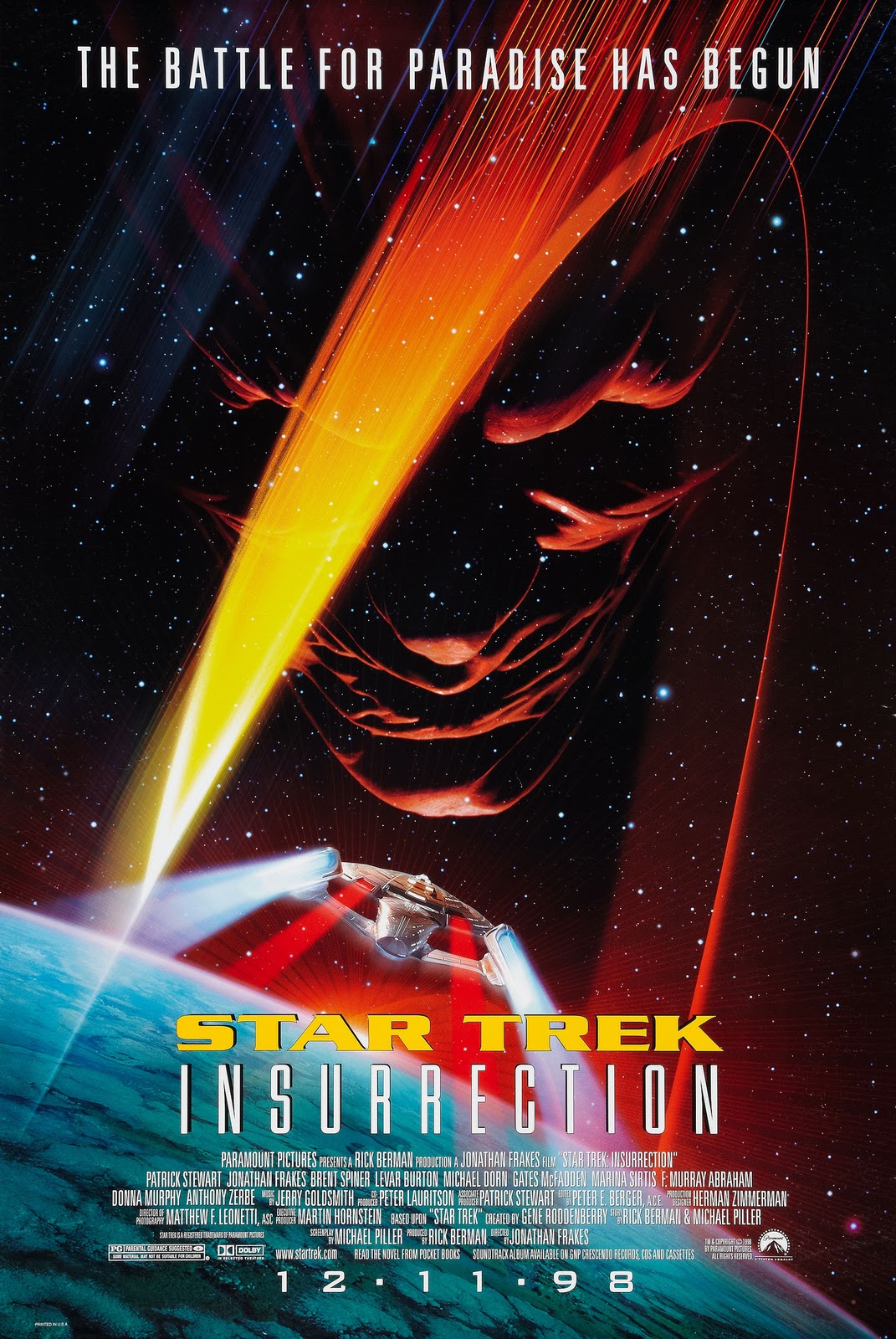
Star Trek: Insurrection Blu-Ray Review

Rated PG (Sci-Fi Action Violence, Mild Language and Sensuality)

Running Time: 1 Hour & 43 Minutes

Cast:
Patrick Stewart-Captain Jean-Luc Picard
Jonathan Frakes-Commander William Riker
Brent Spiner-Lieutenant Commander Data
LeVar Burton-Chief Engineer Geordi La Forge
Michael Dorn-Lieutenant Commander Worf
Gates McFadden-Doctor Beverly Crusher
Marina Sirtis-Counselor Deanna Troi
F. Murray Abraham-Ad'har Ru'afo
Donna Murphy-Anij
Gregg Henry-Subahdar Gallatin
Anthony Zerbe-Vice Admiral Matthew Dougherty
Daniel Hugh Kelly-Sojef
Michael Welch-Artim
Majel Barrett-Ship's Computer

Directed by Jonathan Frakes

Lock and load: Captain Picard and his crew abandon their uniforms in "Star Trek Insurrection."
Note: Part of the "Star Trek The Next Generation Motion Picture Collection" Blu-Ray set. 

After the excellent “Star Trek First Contact,” another installment featuring the TNG cast was a no-brainer for Paramount. With Ronald D. Moore and Brannon Braga busy working on the television series “Deep Space Nine” and “Voyager,” writer/producer Rick Berman teamed up with Michael Piller and set out to make the ninth film much lighter in tone. Released on December 11, 1998 and now available on Blu-Ray, “Star Trek Insurrection,” despite its action-oriented tagline, definitely features a few comedic scenes that borders on cheesiness but is saved thanks to its allegorical plot.

As the Federation is embroiled in a bloody conflict with the Dominion (recounted in DS9), the USS Enterprise-E are on a diplomatic mission when Captain Jean-Luc Picard (Patrick Stewart) receives a disturbing message from Admiral Matthew Dougherty (Anthony Zerbe): Data (Brent Spiner) has malfunctioned while observing a peaceful agrarian race known as the Ba’ku, attacking Starfleet officers and their ally, the Son’a. Although Dougherty rejects the Enterprise’s assistance, Picard becomes suspicious and orders the ship to set a course for the Briar Patch, where the Ba’ku home planet is located. After a harrowing chase, Picard and Worf (Michael Dorn) manage to capture Data and learn that the Ba’ku have warp capability and were a formerly technologically advanced race, but abandoned it to live in harmony with nature. As the Enterprise crew investigates what caused Data to malfunction, they discover a cloaked Federation ship that is home to a gigantic holodeck. Picard concludes that the Ba’ku is to be forcibly removed from the planet but does not know why. Later that night, he beams down to the planet and learns from Anij (Donna Murphy) that the planet’s rings contain metaphasic radiation particles, which allows the Ba’ku to be constantly rejuvenated and lead long lives but blocks communication to outside space. Picard now knows that corrupt Federation officials and the Son’a, led by Ahdar Ru'afo (F. Murray Abraham), are planning to harvest the particles and forcibly remove its people and immediately confronts Dougherty about this blatant violation of the Prime Directive. Dougherty orders the Enterprise to leave immediately but Picard decides to take matters into his own hands and abandons his uniform, and along with his crew, defends the Ba’ku from the villainous Son’a. 

“Star Trek Insurrection” is without a doubt a weaker film compared to “First Contact” and the overall tone is rather cheerful, so there’s a lack of tension even during the space battles. You just know that the Enterprise is going to save the day once again! Some may find the film’s comedic elements groan-inducing but for the most part, I wasn’t bothered and some of them were chuckle-worthy, especially the chase scene where Picard subdues Data with a sing-along to “A British Tar” from the musical “HMS Pinafore” by Gilbert and Sullivan. This time, the theme is an allegory about the forceful relocation of a less advanced race, recalling our violent past with Native Americans when we pushed toward the west. There’s also the idea about the ‘Fountain of Youth’ and our culture’s obsession with trying to look younger. Of course, when such a thing exists, you can guarantee that some people will kill, even annihilate an entire people, to obtain it. Once again, a subplot involves Data learning what it’s like to be a child, reinforcing the film’s friendly tone. ‘The best Star Trek stories are allegorical—in addition to telling an involving story, they're about something other than going into space and blowing up enemy ships’ (James Berardinelli, ReelViews) and this helps “Insurrection” from becoming another “Final Frontier.” 

The acting continues to impress and Patrick Stewart once again delivers an impressive performance as Starfleet’s consummate captain. He plays a less serious role compared to “First Contact” and seems to enjoy it very much (he also had story input and serves as associate producer). Brent Spiner’s Data returns to his more Pinocchio-like quest to learning to be more human and gets some lessons on having fun from a child, played by Michael Welch (whom you might recognize from last year’s “Twilight”). The rest of the cast are in fine shape but some of the TNG cast, like Gates McFadden, Marina Sirtis and even Jonathan Frakes don’t have too much screen-time. Granted, Frakes was also doing double duty as director but this marks a disturbing trend where the TNG films are increasingly focused on Picard and Data. F. Murray Abraham is Ru'afo, who definitely pales in comparison to the Borg Queen and even though he carries out his threats, you never feel like he’s a serious threat. He does sport a weird wrinkly face; there was this scene where he was undergoing a face-lift and the skin is held tight with a staple gun! 

“Insurrection” continues the use of digital effects began in the previous film but due to the change in visual effects studios (Industrial Light & Magic was busy with “Star Wars Episode I The Phantom Menace”), the results are not as good. Still, the design of the Son’a ships look detailed and unique, resembling boomerangs. The only ship battle is the one between the Enterprise and two of the Son’a battle cruisers in the Briar Patch but it’s all too brief. The Blu-Ray is the weakest out of the TNG box set so far but that doesn’t mean it’s a bad thing. Close-ups look great but sometimes the depth of field is too excessive, making the background look fuzzy. At its best, you’ll get some excellent wide shots that show off the Sierra Nevada Mountains and the green colors are very vibrant in the Ba’ku village, creating a sense of a simple, idyllic paradise. The extra clarity sometimes make the digital effects more obvious, such as the Son’a drones which have a slight black outline to them. Although “Insurrection” is the quietest TNG film, audio is strong and dialogue is always crisp. Phaser blasts still have some oomph to them and while Jerry Goldsmith’s score doesn’t reach the epic heights of “First Contact,” this Blu-Ray still makes for an engaging listen despite the subdued sound mix. Special features include a new commentary from director Jonathan Frakes and co-star Marina Sirtis (Frakes generally agrees this is not on par with “First Contact”) and various featurettes detailing the production process such as the visual effects and the makeup for the Son’a, ported from the Collector’s Edition DVD. Once again, Paramount packs quite a large amount of extras so fans won’t be disappointed. 

Released on December 11, 1998, “Star Trek Insurrection” received mixed reviews from critics as they found the film ‘sluggishly paced [and] plays like an extended episode of the TV series,’ averaging a 54% on Rotten Tomatoes. The film made $70 million domestic and $113 million worldwide, a moderate success though Paramount viewed it as a disappointment, leading to the four-year gap with “Star Trek Nemesis.” “Star Trek Insurrection” features a lighter, more optimistic tone in line with Gene Roddenberry’s vision and though some may find it cheesy, this is still a great TNG film due to the allegorical plot, which has always been Star Trek’s greatest strength.

Final Rating: 3.5 out of 5

"And here you are, closing those eyes, trying not to see what bitterness has done to the Son'a, how its turned Ru'afo into a madman. And you, turned you into a coward, a man who denies his own conscious. A coward without the moral courage to prevent an atrocity. You offend me!"

Star Trek: First Contact Blu-Ray Review

Rated PG-13 (Some Sci-Fi Adventure Violence)

Running Time: 1 Hour & 51 Minutes

Cast:
Patrick Stewart-Captain Jean-Luc Picard
Jonathan Frakes-Commander William Riker
Brent Spiner-Lieutenant Commander Data
LeVar Burton-Chief Engineer Geordi La Forge
Michael Dorn-Lieutenant Commander Worf
Gates McFadden-Doctor Beverly Crusher
Marina Sirtis-Counselor Deanna Troi
James Cromwell-Zefram Cochrane
Alfre Woodard-Lily Sloane
Alice Krige-The Borg Queen
Neal McDonough-Lieutenant Sean Hawk
Robert Picardo-Emergency Medical Hologram
Dwight Schultz-Lieutenant Reginald Endicott Barclay III
Jack Shearer-Admiral Hayes
 Majel Barrett-Ship's Computer

Directed by Jonathan Frakes

'I am Locutus of Borg. Resistance...is futile.'
Note: Part of the "Star Trek The Next Generation Motion Picture Collection" Blu-Ray set.

Before the release of this year’s critically acclaimed “Star Trek” from J.J. Abrams that revitalized the aging franchise, there were a total of ten films, and the last four feature my favorite crew from the long running television series, “Star Trek The Next Generation.” While the first six (featuring the crew from the Original Series) are already out as a Blu-Ray box set since May, the TNG films are set to be released next Tuesday. Well, I have the four films sitting right on my desk as I’m typing and I’ve decided to review my favorite of the bunch first, “Star Trek First Contact,” released into theaters on November 22, 1996 and marks the directorial debut of Jonathan Frakes, who also plays Commander Riker. “Star Trek First Contact” is without a doubt, not only the best of the TNG-era films but also of the franchise thanks to an excellent story, eye-popping visual effects and Frakes’ confident direction, who knows the characters inside out. 

After the destruction of the USS Enterprise-D in the previous film, Captain Jean-Luc Picard (Patrick Stewart) now leads his crew on the Enterprise-E, a Sovereign-class ship and the most advanced in Starfleet. After waking up from a nightmare about his time as a Borg, Picard receives a message that a Borg Cube is heading straight for Earth. However, he is ordered to patrol the Neutral Zone in case the Romulans decide to take advantage of the situation but the real reason is that Starfleet feels Picard is too emotionally involved to fight. When he learns that the Borg is decimating the fleet, Picard disobeys his orders and heads for Earth, leading the fleet to victory by destroying the Borg Cube. However, a small sphere escapes and the Enterprise becomes trapped in a temporal vortex while in pursuit. Inside, they glimpse the future and see Earth assimilated by the Borg. The crew resolves to go back to the past and repair whatever damage they’ve done, arriving on April 4, 2063, the day before humanity makes first contact with the Vulcans. Picard now must stop the Borg from preventing Zefram Cochrane’s (James Cromwell) historic warp drive flight or the future he knows will never exist. 

Since the film assumes most people are familiar with the TNG cast, there are no introductions and the story doesn’t waste any time getting into the action. “Star Trek” has always prided itself on offering moral conundrums over epic space battles (although there is one) and “First Contact” is no different. The focus is squarely on Stewart’s Picard, who is still haunted by his experience when he was assimilated by the Borg (from the television series for you non-Trekkies) and wants revenge. There are parallels to Captain Ahab from Herman Melville’s famous novel “Moby Dick” (ironic since Stewart also starred in a made-for-TV film adaptation) and there is this excellent scene where Picard, with forceful conviction says, ‘The line must be drawn here! This far, no further! And I will make them pay for what they've done!’ He interacts with a survivor from the third World War, Lily Sloane (Alfre Woodard) and tells her that in the 24th Century, humanity has evolved to the point where there is no greed or war but despite all of the technology or ‘evolved sensibilities,’ Picard is still susceptible to being overcome by vengeance because of one simple reason: he is human. Another theme touched upon is the idea of hero worship. Zefram Cochrane, played by James Cromwell, was the one who invented the warp drive and ushered in an era of peace for humanity, and the Enterprise crew constantly reminds him of this much to his chagrin. However, history textbooks often have a way of skewing the truth and the real Cochrane is just an old drunk obsessed with rock-and-roll music. When he remarks that he can’t imagine ever meeting this ‘historical figure’ they keep referring to, Riker says that someone once said, ‘Don’t try to be great man. Just be a man, and let history makes its own judgments.’ Cochrane laughs at such ‘rhetorical nonsense’ but learns that he was the one who said it, or will say it in ten years time. Finally there’s the subplot involving Data (Brent Spiner) and the Borg Queen, played with an alluring sexuality by Alice Krige, who tries to resist the Faustian deal he’s presented since it has always been Data’s life-goal to become more human. “First Contact” is very much like the rebooted “Star Trek” in that it also appeals to non-fans but doesn’t lose sight of what made people fall in love with Star Trek in the first place. It’s a shame this success wasn’t able to be replicated in the next two installments. Despite the film’s serious tone, there are also some lighthearted moments, such as when Deanna Troi (Marina Sirtis) gets drunk and mouths off at Riker (‘Timeline? This is no time…to talk about time! We don't have the time!’). Most of the comedy is at Cromwell’s expense as he’s overwhelmed by all the hero worship. He even pokes fun at the fact that in the entire history of Star Trek, not one crew member is ever shown going to the bathroom! 

The acting is amazing and it has to be considering that these people have been playing the same roles for over eight years. Patrick Stewart is at his best as Picard with a commanding screen presence that makes you care about what he’s going through. The rest of the TNG crew does a great job as well, although some of the cast, such as Gates McFadden (Dr. Beverly Crusher) and Marina Sirtis, don’t have much to do. James Cromwell is hilarious as Zefram Cochrane, going from drunken stupor to finally accepting his place in history. Alfre Woodard has some great scenes with Stewart when she drags him back to reality and calls him out on his hypocrisy. Finally there's Alice Krige as the Borg Queen, who's creepily sexy thanks to the makeup effects and reminds me of Kerrigan from Blizzard's StarCraft. “First Contact” featured some of the best visual effects and makeup at the time, putting it on par with “Star Wars.” When the Enterprise-E first appears, you’ll be in awe at its sleek design and the hard work putting in all the little details. The space battle between the Borg Cube and the fleet is impressive with phasers and quantum torpedoes flying everywhere, and if you’re quick, you might even catch a glimpse of the Millennium Falcon! The Borg themselves are menacing automatons as they slowly advance on the crew with only one purpose: to assimilate. 

The Blu-Ray is absolutely stunning and miles away from its DVD counterpart. The film’s opening scenes where Picard relives his assimilation reveal incredible detail, as do close-up shots. Black levels are solid although some of the neon colors (mainly from Borg Cube) look a little garish. If I was watching this for the first time, I wouldn’t believe this film was made in 1996 given how excellent the transfer is. Audio is suitably excellent with Jerry Goldsmith’s epic and emotionally resonant score making for an engaging listen. Dialogue is sharp and the space battle features wide dynamic range as phaser fire bombard the Borg Cube’s outer hull. Special features are packed and includes three audio commentaries from Damon Lindelof and Anthony Pascale (who runs TrekMovie.com), director Jonathan Frakes, and writers Brannon Braga and Ronald D. Moore, plus featurettes on the visual effects, Jerry Goldsmith, the possibilities of first contact with an alien race and many more. Paramount definitely went all-out on this Blu-Ray and fans won’t be disappointed. 

When “Star Trek First Contact” was released in 1996, reviews were overwhelmingly positive with a 92% on Rotten Tomatoes, making it the second highest rated Trek film behind Abrams’ “Star Trek.” The film made $92 million domestic and $146 million worldwide, which doesn’t seem high by today’s standards but keep in mind that outside the fan-base, the mainstream audience generally viewed Star Trek with disdain up until the release of the new film. “Star Trek First Contact” is an excellent entry in the franchise with the TNG cast in top form and although neophytes might not get all the in-jokes or references, there’s still enough here to hold their attention. With brilliant special effects and a frightening, unstoppable villain, you’ll come to know the meaning of ‘Resistance is Futile!’

Final Rating: 5 out of 5

"I will not sacrifice the Enterprise. We've made too many compromises already; too many retreats. They invade our space and we fall back. They assimilate entire worlds and we fall back. Not again. The line must be drawn here! This far, no further! And I...will make them pay for what they've done!"

Star Trek: Generations Blu-Ray Review

Rated PG (Sci-Fi Action and Some Mild Language)

Running Time: 1 Hour & 58 Minutes

Cast:
Patrick Stewart-Captain Jean-Luc Picard
William Shatner-Captain James T. Kirk
Jonathan Frakes-Commander William Riker
Brent Spiner-Lieutenant Commander Data
LeVar Burton-Chief Engineer Geordi La Forge
Michael Dorn-Lieutenant Commander Worf
Gates McFadden-Doctor Beverly Crusher
Marina Sirtis-Counselor Deanna Troi
Malcolm McDowell-Dr. Tolian Soran
Whoopi Goldberg-Guinan
Barbara March-Lursa
Gwynyth Walsh-B'Etor
James Doohan-Captain Montgomery 'Scotty' Scott
Walter Koenig-Commander Pavel Chekov
Alan Ruck-Captain John Harriman
Jacqueline Kim-Ensign Demora Sulu
Majel Barrett-Ship's Computer

Directed by David Carson

You have two of the finest captains in the history of Starfleet and what do you have them do? Cook breakfast.
Note: Part of the "Star Trek The Next Generation Motion Picture Collection" Blu-Ray set.

“Star Trek The Next Generation” finally ended its seven year run in May of 1994 but that wasn’t the end for Captain Picard and the crew of the USS Enterprise-D, because the seventh film, “Star Trek Generations,” was just around the corner. Released on November 18, 1994 and now available on Blu-Ray, “Generations” was supposed to be a ‘passing of the torch’ moment with the much-hyped meeting of Picard and Kirk from the Original Series. To be honest, this is my least favorite of the TNG films because it feels like an extended episode of the TV series. Despite being bogged down by a rather bland story and weak villains, there are still enough moments to win over most Trek fans. 

The USS Enterprise-B is about to begin its maiden voyage and former captains James T. Kirk (William Shatner), Montgomery Scott (James Doohan) and Commander Pavel Chekov (Walter Koenig) are on-hand to send the ship on her way. However, they receive a distress call about two ships trapped in some sort of ‘energy ribbon’ and the Enterprise is the closest ship to conduct a rescue. The ships happen to carrying El-Aurian refugees who are escaping from the Borg and while some of them managed to be rescued, the Enterprise becomes trapped in the energy ribbon. Kirk descends to the Engineering Bay to simulate to effect of a photon torpedo to break free and he succeeds, although he is killed after a hull breach. 78 years later, Captain Jean-Luc Picard (Patrick Stewart) of the USS Enterprise-D is attending a ceremony to promote Worf (Michael Dorn) to the rank of Lieutenant Commander when they receive a distress call from the Amargosa Solar Observatory. Commander Riker (Jonathan Frakes) and his away team find only one survivor, a Dr. Tolian Soran (Malcolm McDowell), and the body of a dead Romulan. While Data (Brent Spiner) and LaForge (LeVar Burton) are investigating the observatory for clues, they come under attack by Soran, who launches a solar probe to destroy the nearby Amargosa star. He captures LaForge and is beamed to safety with the help of the Duras sisters, Lursa and B'Etor (Barbara March and Gwynyth Walsh). Picard learns from Guinan (Whoopi Goldberg) that Soran is trying to get back into the Nexus, a place where time has no meaning and where one’s every dream becomes reality. With time running out, Picard and his crew must find a way to stop Soran and enlist the aid of a long-dead Starfleet captain. 

The plot of “Star Trek Generations” definitely feels like little more than an excuse to have Picard and Kirk team up and is rife with a few plot holes. One of the more obvious is when Picard is in the Nexus and is told he can leave to any point in time since time has no meaning. He chooses to arrive mere minutes before Soran is about to destroy the Viridian star when he could’ve just picked any time and catch Soran unawares. Writer Ronald D. Moore reasoned that it was because Picard didn’t want to tamper with the timeline, a lame excuse if I ever heard any. Still, like all Trek films, there is a theme and this time it’s time and mortality. When Picard gets the news that his older brother and nephew had died in a fire, he remarks that he was become aware that ‘there were fewer days ahead than they are behind,’ meaning he has spent most of life dedicated to Starfleet that he has neglected to start a family and raise children. Kirk also feels this way in the prologue when he questions how Hikaru Sulu found time for family. By the end of the film, Picard comes to the conclusion that there’s no point lamenting on what you could or couldn’t do but to try to make the most of whatever time you have left (‘I rather believe that time is a companion who goes with us on the journey and reminds us to cherish every moment, because it will never come again’). Of course, Soran does not see it this way and wants to use the Nexus as a way of bringing his family back after they were attacked by the Borg. Even though what the Nexus creates is all an illusion, he doesn’t care. Like the sequel, “First Contact,” there’s a subplot involving Data, who has now taken that leap of faith and installed the emotion chip from his evil brother, Lore. This leads to much hilarity such as when he starts guffawing at a joke made seven years ago and expresses his love of scanning life-forms through song. Some of it borders on being cheesy but come on, it’s Data! 

The acting is generally good and Patrick Stewart continues to have a commanding presence whenever he’s on-screen. Unfortunately, when he finally meets Kirk face-to-face, the moment just isn’t as powerful as I thought it would be. Also,  when Kirk finally does go down fighting, the scene doesn’t pack any emotional punch. Malcolm McDowell’s Soran also doesn’t appear to be menacing at all but it’s more the fault of the writers in handling the character than his performance. The special effects are a cut above from the TNG series but lacks the ‘wow effect’ when I first laid eyes on the Enterprise-E in “First Contact.” Although Industrial Light & Magic did create a digital model of the Enterprise-D, they still used physical models to keep costs down. The most impressive set-piece would be the Stellar Cartography room, which provides a three-dimensional view of space and various planets on a two-dimensional screen. There’s also a ship battle between the Enterprise and a Klingon Bird of Prey but it pales in comparison to the one in “First Contact.” The film crew also tore up the Enterprise real good with consoles exploding everywhere and the scene when it crash lands into Viridian III is the most visually impressive. 

The Blu-Ray looks very good for a film made in 1994 and close-up shots on the actors/actresses faces reveal incredible detail. Hell, I could see every line on Data’s face! However, it makes much of the dated effects look like it came from the Sci-Fi Channel and you’ll notice a slight outline whenever a person is standing behind a blue-screen. Audio is better as weapon sounds like disrupter fire or photon torpedoes pack quite a punch, especially during the space battle over Viridian III. Things get even louder as the Enterprise crashes into the planet below and you can feel the floor shake as it skids to a stop in a forest. Special features include audio commentaries from director David Carson and Manny Coto, writers Brannon Braga and Ronald D. Moore and various featurettes detailing the production process such as visual effects and creating the weapons. Like “First Contact,” Paramount spared no effort in packing the disc with extras. 

“Star Trek Generations” received quite a large amount of hype leading up to its release (including an official website dedicated to the film) but critical reception was mixed, with a 48% on Rotten Tomatoes. The film made $76 million domestic and $118 million worldwide, impressive considering it had a $35 million production budget. “Star Trek Generations” is an average Trek film with a few good moments but the story is nothing more than an excuse to bring Picard and Kirk together. While it succeeds in passing the torch to the TNG crew, one can’t help but feel like they’re watching a double length TV episode of the series.

Final Rating: 3 out of 5

"Someone once told me that time was a predator that stalked us all our lives. I rather believe that time is a companion who goes with us on the journey and reminds us to cherish every moment, because it will never come again. What we leave behind is not as important as how we've lived."

Friday, August 14, 2009

District 9 Review

Rated R (Bloody Violence and Pervasive Language)

Running Time: 1 Hour & 52 Minutes

Cast:
Sharlto Copley-Wikus Van Der Merwe
Vanessa Haywood-Tania Van Der Merwe
Jason Cope-Grey Bradnam (UKNR Chief Correspondent)
Nathalie Boltt-Sarah Livingstone (Sociologist)
Sylvaine Strike-Dr. Katrina McKenzie
John Summer-Les Feldman (MIL Engineer)
William Allen Young-Dirk Michaels
Nick Blake-Francois Moraneu (CIV Engineer Team)
Jed Brophy-James Hope (Police Officer)
Louis Minnaar-Piet Smit
Marian Hooman-Sandra Van Der Merwe
Johan van Schoor-Nicolas Van Der Merwe
Vittorio Leonardi-Michael Bloemstein (MNU Alien Civil Affairs)
Mandla Gaduka-Fundiswa Mhlanga
Stella Steenkamp-Phyllis Sinderson (MNU Alien Relations)
David James-Koobus Venter
Tim Gordon-Clive Henderson (Entomologist)

Directed by Neill Blomkamp

Humanity comes face-to-face with extraterrestrial life in Neill Blomkamp's "District 9."
So far, this summer has proven a general disappointment for movies, dominated by big, special effects laden films like “Transformers: Revenge of the Fallen” and “G.I. Joe: The Rise of Cobra” that appeal to the lowest common denominator. Make no mistake, my feelings about those films are evident and whether you choose to agree with me or not is up to you. As we head into the final weeks of August, along comes the long-awaited “District 9,” a science fiction film directed by newcomer Neill Blomkamp with “Lord of the Rings” director Peter Jackson serving as executive producer. Blomkamp was set to direct “Halo,” based upon the famed video game franchise from Microsoft and Bungie Studios but the project has now been defunct due to budgetary concerns from 20th Century Fox and Universal Pictures. Jackson felt obligated to give Blomkamp a chance to direct another film and decided to make a full-length adaptation of his short film, “Alive in Joburg.” After seeing the film, I am left shaken as to how original and brutal “District 9” is as Blomkamp successfully crafts one of the most emotionally gut-wrenching tales that explore the darkest depths of the human soul but also their capacity for good. In a summer full of mediocre films made for mass consumption, “District 9” is a godsend and you’ll be hard pressed not to leave the theater deeply affected.

SOME SPOILERS FOLLOW! They came 28 years ago, a large alien mothership just hovering over the city of Johannesburg, South Africa. For three months, nothing happened and it was decided that a small research group would forcibly enter the ship. What they found was thousands of insect-like aliens starving and on the verge of death. At first, people welcomed them with open arms and tried to nurse them back to health at the holding facility dubbed District 9, but the aliens quickly became a drain on society. District 9 began to devolve into a colony of shantytowns, with crime rampant and the aliens, called derogatively ‘prawns,’ living in terrible conditions. Control over the colony was transferred over to Multi-National United, who cared little for the aliens’ welfare but instead wanted to reverse engineer their technology. They have been unsuccessful as the weapons only interact with alien DNA. Wikus van der Merwe (Sharlto Copley) is assigned to evict the 1.8 million aliens to District 10 but after an accident (which I will not reveal), his life is turned upside down and he is forced to become a fugitive. His only salvation lies in Christopher Johnson, an alien with a son who desperately wants to go home, and together they unlock the secrets of District 9.

This is a film that you should go in with as little knowledge as possible and the trailers have done a good job of introducing the basic premise, but the mystique is still preserved. The allegory of “District 9” is obvious: apartheid but applied to extraterrestrials. We know the horror of apartheid between whites and blacks in South Africa but how would we react to aliens just suddenly popping up? How we interact with them will certainly define the human race forever. Blomkamp shows that at first, we welcome these aliens, I mean, anyone seeing someone so malnourished would do the right thing and help them. Of course, helping them becomes a drain on society and people begin to say that these ‘prawns’ should just go. Their problems don’t concern us and whatever they’re dealing with pales in comparison with what we go through. This reminds me of how the American public slowly started to call for the withdrawal of soldiers of Iraq. The economy was tanking so why the hell are we wasting time trying to save some backwater country? As public opinion turns against the aliens, they treat them with disdain and take advantage of them. Thugs begin setting up shop, trying to get their hands on their weapons and even outright killing them to consume their flesh in order to gain ‘special powers.’ Corporations are driven by greed as they try to reverse engineer their technology and have no qualms performing horrific experiments on the aliens. District 9 is a trash heap, a concentration camp where its residents scrape by on nothing but garbage. In terms of different races, everyone tries to look out for themselves and no matter how much we say we accept everyone, deep down you’re just as prejudiced as you and me. We’ve just gotten to the point where we’re good at hiding them. When you look at the treatment of these aliens, it’s just a mirror showing us who we truly are deep down.

Out of this chaos arrives Wikus van der Merwe, played with such excellence and sincerity by Sharlto Copley, a virtual unknown actor from South Africa. When we first meet him, he’s nothing but a pencil-pusher and brown noser. While serving eviction notices to the aliens, he curses and treats them with extreme disrespect. Once the accident happens, he finally experiences first-hand the extreme cruelty of what the aliens go through. His superior, who just happens to be his father-in-law, immediately allows him to be experimented upon and the scenes where he’s pleading to see his wife (Vanessa Haywood) are gut-wrenching to watch. Once he’s a fugitive, he enlists the help of Christopher Johnson, an alien single father who’s trying to save his people. Wikus still has selfish means and is using Christopher for his own gain but as he achieves his moral awakening, he decides to put his life on the line and allow his new friend the chance to save his people.

The alien themselves are brought to life through Jackson’s own Weta Digital and they look amazingly lifelike and sympathetic. They’re black in color and have a shrimp-like appearance, communicating through clicks and chirps. One of their most unusual quirks is their love for cat food. Christopher and his son are at the heart of the story. Whenever the camera is up-close, their eyes are so expressive, revealing how much they’re on the verge of giving up. The son, as he stares at a hologram of his homeworld, asks his father how many moons it has and when he will go there but Christopher holds a pamphlet saying they can’t, because they are being relocated to District 10. There’s also another scene where the little guy curiously looks at Wikus and remarks that they’re the same. The relationship between parent and child shows more humanity than Wikus’ own family. It’s easy to dismiss them as nothing more as CG creations but that line of thought is absolutely wrong. As the film convinces us that mankind is the enemy, one wouldn’t feel any guilt if the aliens unleashed hell like the ones in “Independence Day.” In fact, it would be just. The ship itself is never shown off like another CGI effect and is little more than an afterthought, allowing us quick glimpses while remaining fuzzy in the background. The second half explodes with quite a lot of action, as Wikus and Christopher fight their way through MNU with alien weaponry, which isn’t all that advanced but absolutely destructive. You’ll see quite a lot of bodies explode and it earns it’s R-rating in spades. There’s also the Mech scene and that’s when the film has you firmly in its grasp as you’re wondering if there’s any hope for Wikus or Christopher. Blomkamp utilizes a documentary-style to tell the story through the use of testimonials looking back at these events and their effects on the human community. It lends the movie realism and allows us to accept what we’re being told as ‘fact.’

Released nationwide today, pre-release buzz of “District 9” has been immensely positive, and critic reviews reflect with that, with an 87% on Rotten Tomatoes. Made on a relatively small budget of $30 million, the film may make three times this amount through positive word-of-mouth, though when I was at the theater today, there was only a moderate amount of people. “District 9” also leaves many of its plot threads unresolved so while a sequel is likely, I think it’s better to leave it as a stand-alone film and let it foster debate of what happens next. This film has single-handedly saved a summer dominated by inane toilet humor and loud explosions and one will leave the theater disturbed when ‘gazing through the dark lens of…human nature’ (James Berardinelli, ReelViews). Berardinelli also wishes that the ‘inhabitants of Earth never encounter visitors from another planet because the reality of how we might interact with them could be close to what is depicted here, and that's a depressing thought.’ “District 9” is brutal and cynical, depicting humanity at its worst but also at their best. No question this is the best movie of the summer by far and has all the makings of a classic science-fiction masterpiece.

Final Rating: 5 out of 5

"There are a lot of secrets in District 9."